
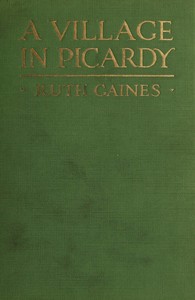
A Village in Picardy by Ruth Gaines
I picked up 'A Village in Picardy' expecting a historical account, but what I found was something much more intimate. Ruth Gaines, an American woman working with the YMCA, arrived in the shattered French region of Picardy in 1918. Her book is a series of vivid snapshots from her time in the village of Cantigny, which was briefly a rest stop for American troops of the 1st Division before they headed into one of the first major U.S. battles of the war.
The Story
There isn't a traditional plot with a beginning, middle, and end. Instead, Gaines takes us by the hand and shows us daily life. We see the exhausted French villagers, who have lived under German occupation, cautiously interacting with the boisterous, naive American 'doughboys.' We sit in the makeshift YMCA hut where soldiers write letters home, play checkers, and try to forget what's coming. We walk through ruined orchards and bullet-pocked houses. The 'story' is the buildup of tension—the calm before the storm. You meet these young men, learn their nicknames and their hopes, all while knowing that soon, many will march out to fight at the Battle of Cantigny. The book ends as the battle begins, leaving the fate of the village and the soldiers hanging in the air.
Why You Should Read It
This book is powerful because of its simplicity. Gaines doesn't lecture or analyze grand strategies. She just observes. Her writing makes you feel the mud, the chill, the awkward laughter, and the profound sadness hanging over everything. You get attached to these characters in just a few pages. When she describes a soldier carefully mending his socks, or an old Frenchwoman sharing her last bit of coffee, it tells you more about war than any statistic ever could. It’s a reminder that history is made of people, not just dates and troop movements. Her perspective as a civilian woman in a military zone is also unique, focusing on care, connection, and the quiet resilience of everyday life amidst chaos.
Final Verdict
This is a perfect book for anyone who feels that big history books can feel distant. If you love character-driven stories, personal diaries, or accounts that focus on the home front and human connections during war, you'll be captivated. It’s also a great, short read for anyone interested in World War I from a ground-level, non-combatant view. Just be prepared—it’s not a cheerful story, but it’s a deeply human and memorable one. It’s the kind of book that makes you pause and think long after you’ve turned the last page.
Dorothy Garcia
1 year agoI started reading out of curiosity and the clarity of the writing makes this accessible. Exactly what I needed.



Kenneth Robinson
1 year agoThis is one of those stories where it challenges the reader's perspective in an intellectual way. Exceeded all my expectations.