
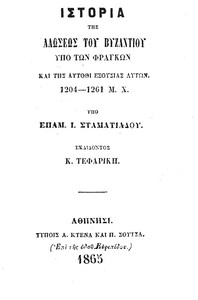
Ιστορία της Αλώσεως του Βυζαντίου υπό των Φράγκων και της αυτόθι εξουσίας αυτών
Most stories about the Fourth Crusade end in 1204 with the smashing of Constantinople's famous walls and the looting of its treasures. Stamatiades asks a simple but powerful question: What happened the next day? His book picks up right where others leave off, following the Frankish (mostly French and Flemish) crusaders who decided not to go home. Instead, they carved up the Byzantine Empire like a pie.
The Story
The narrative follows the chaotic birth and shaky life of the Latin Empire of Constantinople. It’s not a clean, heroic conquest. We see rival leaders like Baldwin of Flanders and Boniface of Montferrat scrambling for the best pieces of land, from Greece to the coast of Asia Minor. The book maps out this new, strange world where European feudal castles rose beside ancient Byzantine churches. It chronicles the constant fighting: against leftover Byzantine Greek states that refused to die, against the rising Bulgarian Empire to the north, and even amongst the Latins themselves. The story is one of a fragile government, built on military victory but struggling with empty coffers, too few soldiers, and a resentful local population who saw their new rulers as crude and illegitimate.
Why You Should Read It
This book shines because it forces you to look beyond the big battle. Stamatiades, writing in the 19th century with access to sources many earlier historians ignored, focuses on the human and administrative drama. You get a real sense of the daily tension in occupied Constantinople. How did a Greek merchant and a Latin knight interact in the market? What laws applied? The author doesn't just list kings and battles; he shows the mechanisms of a failed state. You see smart decisions and catastrophic blunders with equal clarity. It reads like a political thriller about a regime living on borrowed time, making it feel incredibly immediate and relevant.
Final Verdict
This is a perfect read for anyone who loves deep-cut historical narratives. If you enjoyed books about the Crusades or Byzantine history but felt the story was incomplete, this is your missing chapter. It’s also great for readers interested in the realities of empire, occupation, and cultural clash. Be warned, it’s a detailed history, so a basic familiarity with the era helps. But if you're willing to dive in, Stamatiades offers a compelling, ground-level view of one of history's most fascinating 'what if' moments that actually happened.
This masterpiece is free from copyright limitations. Share knowledge freely with the world.









Sarah Hernandez
1 month agoComparing this to other titles in the same genre, the emphasis on ethics and sustainability within the topic is commendable. A rare gem in a sea of mediocre content.