
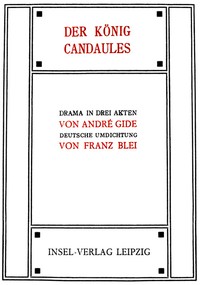
Der König Candaules: Drama in drei Akten by André Gide
André Gide's 'The King Candaules' is a tight, three-act play that takes an ancient tale and injects it with modern psychological tension. Written in 1901, it feels surprisingly fresh and urgent.
The Story
King Candaules of Lydia is wealthy, powerful, and deeply in love with his wife, Queen Nyssia. He's so captivated by her beauty that he's tormented by a strange idea: it's unfair that he's the only one who gets to appreciate it. He confides in his close friend, the soldier Gyges, and proposes a reckless scheme. He wants Gyges to hide in their bedroom and watch the queen undress, so he too can witness her perfection. Gyges is horrified and refuses, but Candaules, blinded by his own twisted logic, insists. He sees it as an act of supreme friendship. The plan is set in motion, but Nyssia discovers the intruder. The fallout is swift and brutal. The queen confronts Gyges and presents him with an impossible choice: kill the king who betrayed her, or be killed himself for violating her. The play races toward its inevitable, tragic conclusion.
Why You Should Read It
This isn't a play about grand battles or mythical creatures. It's a razor-sharp look at human flaws. Gide makes you understand each character's perspective, even when you disagree with them completely. Candaules isn't a villain; he's a man so intoxicated by an idea that he can't see the people in front of him. Nyssia transforms from an object of desire into a formidable force of vengeance. And poor Gyges is caught in the middle, a good man wrecked by another's vanity. I kept thinking about how we all have things we want to show off—our homes, our successes, our partners—and where that line is between sharing joy and committing a profound violation. The dialogue is crisp, the moral dilemma is gripping, and it all happens in about 60 pages. It's the kind of story that starts a great conversation.
Final Verdict
Perfect for readers who love classic stories retold with a psychological edge, or anyone who enjoys a tense, one-sitting drama. If you're a fan of authors like Jean-Paul Sartre or Albert Camus, you'll see Gide as a fascinating precursor exploring similar themes of choice and consequence. It's also a great entry point into Gide's work if his longer novels seem daunting. Just be warned: it might make you side-eye anyone who says, 'I just want you to see something amazing.'
This title is part of the public domain archive. Preserving history for future generations.
Robert Martinez
7 months agoA brilliant read that I finished in one sitting.

Karen Lopez
1 month agoWhile browsing through various academic sources, the data points used to support the main thesis are quite robust. A rare gem in a sea of mediocre content.