
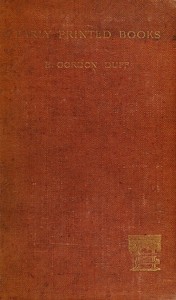
Early Printed Books by E. Gordon Duff
Let's clear something up right away: this is not a dry textbook. E. Gordon Duff's Early Printed Books is a tour through the most exciting garage-sale-meets-tech-revolution in history. Duff, writing over a century ago, had a passion that still feels fresh. He wasn't just listing facts; he was introducing us to the rockstars and rogue engineers of the 15th century.
The Story
There isn't a traditional plot with characters, but there is a fantastic narrative arc. It starts in Mainz, Germany, with Johannes Gutenberg's big idea. But Duff quickly moves on from that famous name to explore what happened next. He follows the printers—often goldsmiths or merchants—as they packed up their presses and type and spread across Europe like intellectual missionaries. The 'story' is in the books themselves: the first travel guides, the early cookbooks, the pamphlets that fueled religious debates, and the beautiful but often error-riddled first print runs. Duff shows us the trial and error, the piracy, and the sheer entrepreneurial hustle that turned a novel machine into the engine of the Renaissance and Reformation.
Why You Should Read It
Reading this book changes how you see every book on your shelf. Duff makes you appreciate the physical object—the choice of font, the layout of the page, the quirky illustrations. You realize that early printers were designers and problem-solvers. My favorite parts are when he points out the mistakes: a page printed upside down, a hilarious typo in a serious text. It reminds you that real people, probably tired and covered in ink, made these things. The book argues, without ever saying it directly, that the printing press didn't just make books cheaper; it standardized knowledge, challenged authority, and created the idea of a 'public' with shared information. It's a powerful reminder that a technological shift can reshape everything.
Final Verdict
Perfect for history buffs who like 'behind-the-scenes' stories, book lovers who want to know more about the physical life of their paper friends, and anyone curious about how media revolutions actually happen. It's accessible, filled with fascinating details, and surprisingly fast-paced. It’s a foundational text that feels like a friendly lecture from the most enthusiastic professor you never had. Keep in mind it was written in 1893, so some details have been updated by newer research, but as a passionate, engaging starting point into the world of incunabula (books printed before 1501), it's still a brilliant read.
This book is widely considered to be in the public domain. Share knowledge freely with the world.
Brian Hernandez
1 year agoWithout a doubt, it challenges the reader's perspective in an intellectual way. I will read more from this author.
Nancy Allen
1 year agoFrom the very first page, the author's voice is distinct and makes complex topics easy to digest. Thanks for sharing this review.
Elijah King
1 year agoI stumbled upon this title and the plot twists are genuinely surprising. I will read more from this author.
Aiden Rodriguez
3 months agoI didn't expect much, but the storytelling feels authentic and emotionally grounded. Thanks for sharing this review.

Linda Brown
1 week agoEssential reading for students of this field.