
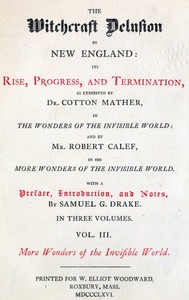
The Witchcraft Delusion in New England: Its Rise, Progress, and Termination…
Let's be clear: this is not a beach read. Cotton Mather's The Witchcraft Delusion in New England is a dense, challenging collection of sermons, arguments, and accounts from the 1690s. It's the original playbook of the Salem witch trials, written by one of its most influential supporters.
The Story
There isn't a traditional plot. Instead, Mather builds a case. He describes strange fits afflicting young girls in Salem Village, which are blamed on witchcraft. He lays out the 'evidence' used in court, like the controversial idea of 'spectral evidence'—where an accuser claims to see the ghost or specter of the witch tormenting them. The book defends the judges' actions, argues for the reality of the devil's work in the colony, and urges continued vigilance against evil. It's a real-time justification for a community tearing itself apart.
Why You Should Read It
This book is fascinating because it shows the mindset. Mather wasn't a cartoon villain; he was a brilliant, devout man trying to protect his community from what he saw as a literal invasion from hell. Reading his passionate, detailed arguments is unsettling. You see how logic bends under fear, how faith can be weaponized, and how the desire for order can create incredible injustice. It’s a masterclass in persuasion and a stark warning from history. You're not just learning about the trials; you're inside the head of someone making them happen.
Final Verdict
This is essential reading for anyone seriously interested in American history, the Salem trials, or the psychology of mass hysteria. It's perfect for history buffs, true crime fans who want the original documents, or readers who love analyzing primary sources. Be warned: the language is old-fashioned and heavy. But if you can push through, you'll get an understanding no modern summary can ever give you. Skip it if you want a light narrative, but pick it up if you want to confront the raw, complicated truth of a dark American chapter.
This digital edition is based on a public domain text. You do not need permission to reproduce this work.
Robert White
2 months agoRecommended.
Kevin Young
8 months agoThe index links actually work, which is rare!


Ashley Scott
1 year agoI have to admit, it manages to explain difficult concepts in plain English. A valuable addition to my collection.