
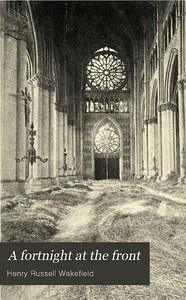
A Fortnight at the Front by Henry Russell Wakefield
In 1915, Henry Russell Wakefield, the Bishop of Birmingham, did something extraordinary. He arranged to visit the British Expeditionary Force on the Western Front for two weeks. This book is the direct result of that journey. It’s structured as his personal account, written with the immediacy of someone who has just stepped off the boat from France.
The Story
There isn't a traditional plot. Instead, Wakefield takes us with him as he moves from headquarters to the front lines. We see the war through his astonished eyes. He describes the shocking scale of the logistics, the thunder of the artillery that becomes a constant background noise, and the surreal sight of towns half-reduced to rubble. The heart of the book is in the trenches themselves. He shares conversations with soldiers—officers and enlisted men alike—listening to their stories, their fears, and their dark humor. He attends services in bombed-out buildings, offers what comfort he can, and tries to grasp the daily reality of a conflict that was, for most people back home, just headlines in the paper.
Why You Should Read It
What makes this book stick with you is its honest, unpolished perspective. Wakefield doesn't pretend to be a hero or a military expert. He’s often confused, overwhelmed, and deeply moved. His writing captures small, human details that bigger histories miss: the quality of the mud, the taste of army tea, the way men could joke about their rations one minute and stare silently into the middle distance the next. He’s particularly good at showing the disconnect between the war at home and the war over there. His reflections on leadership, morale, and the spiritual crisis of the conflict feel genuine because he’s wrestling with them in real time. You're not getting analysis from a historian fifty years later; you're getting the raw, first impressions of a smart, compassionate observer who was there.
Final Verdict
This is a perfect, compact read for anyone interested in World War I beyond the dates and battles. It’s for readers who love primary sources, diaries, and getting a feel for history through someone else’s shoes. If you enjoyed the personal touch of books like All Quiet on the Western Front but want a view from outside the ranks of the soldiers, Wakefield’s account is fascinating. It’s also surprisingly accessible—he writes clearly, without pretension. Just be ready for a perspective that is very much of its time (he was a bishop in 1915, after all), but one that is fundamentally humane, curious, and unforgettable.
The copyright for this book has expired, making it public property. It is available for public use and education.
Nancy Johnson
11 months agoThe methodology used in this work is academically sound.
Barbara Taylor
11 months agoThe layout is perfect for tablet and e-reader devices.
Elizabeth Hernandez
10 months agoThe author provides a very nuanced critique of current methodologies.
Thomas Lee
1 year agoAs a professional in this niche, the insights into future trends are particularly thought-provoking. I'm genuinely impressed by the quality of this digital edition.







Patricia Brown
1 month agoThe peer-reviewed feel of this content gives me great confidence.