
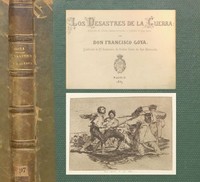
Los Desastres de la guerra: by Francisco Goya
Let's clear something up first: this isn't a novel. Francisco Goya's 'Los Desastres de la Guerra' (The Disasters of War) is a series of 82 prints. Think of it as a graphic novel from 1810, but one with no superheroes and absolutely no happy ending. Goya created these during and after the Peninsular War, a bloody conflict where Spanish civilians fought Napoleon's French troops. He didn't publish them in his lifetime, likely because the truth was too dangerous.
The Story
There's no linear plot with characters. Instead, the 'story' is a descent. It opens with the bleak title 'Sad presentiments of what is to come.' We then see the brutal reality of combat—not glorious charges, but executions, stabbings, and chaos. The focus quickly shifts from the battlefield to the town. This is the real punch. We see the aftermath: famine so severe people eat tree bark, rampant robbery, pointless acts of torture, and piles of anonymous dead. The later prints get almost mythical, featuring monstrous figures and haunting captions like 'I saw this' and 'This is the truth.' It's a relentless, visual diary of a society breaking apart.
Why You Should Read It
Because it cuts through all the noise. We're used to war stories that are sanitized or turned into exciting action movies. Goya gives us none of that. His art is raw, messy, and focuses on the human cost. The faces of his subjects—full of terror, despair, or blank emptiness—stick with you. He shows how violence corrupts everyone, attacker and victim alike. Looking at these prints, you're not learning dates and generals' names; you're feeling the weight of history's darkest moments. It makes you ask hard questions about power, suffering, and what we're capable of. It’s art as a witness, and it refuses to let us look away.
Final Verdict
This is for anyone who believes art should challenge you, not just decorate a wall. It's perfect for history buffs who want to go beyond textbooks and feel the era's anguish, and for graphic novel readers interested in the roots of visual storytelling. It's also for anyone feeling numb to the headlines; Goya's work is a brutal, necessary reminder of war's true face. Be warned: it is deeply unsettling. But its power is undeniable. This isn't a pleasant read, but it is an essential one.
This content is free to share and distribute. Feel free to use it for personal or commercial purposes.
Liam White
2 months agoGreat read!
Richard Young
1 year agoBased on the summary, I decided to read it and the author's voice is distinct and makes complex topics easy to digest. Truly inspiring.
Margaret Smith
1 year agoI started reading out of curiosity and the narrative structure is incredibly compelling. One of the best books I've read this year.


Kevin Clark
1 year agoI had low expectations initially, however the depth of research presented here is truly commendable. A true masterpiece.