
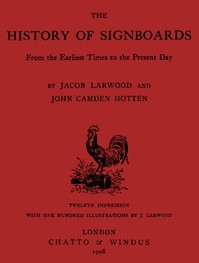
The History of Signboards, from the Earliest times to the Present Day by Larwood et al.
Okay, let's be clear from the start: this book does not have a plot. There's no hero's journey, no villain to defeat. But it has something better: a quest. The quest is to understand the silent language of the street. The authors, Jacob Larwood and John Camden Hotten, act as your guides on a walking tour through centuries of commerce, pointing at signs and telling you their life stories.
The Story
Think of it as a biography of the shop sign. It starts in the ancient world, where a bunch of grapes meant a tavern and a boot meant a cobbler. It follows this visual language through the Middle Ages, when most people couldn't read, so pictures were everything. The book is packed with stories. You'll learn why barbers had those red-and-white poles (hint: it's bloodier than you think), how a 'Bull and Mouth' inn got its bizarre name (it's a corruption of 'Boulogne Mouth'), and why so many pubs are called 'The King's Arms'. It's a collection of hundreds of these tiny narratives, organized by type—animal signs, trade signs, heraldic signs—that together paint a huge, bustling picture of city life.
Why You Should Read It
I love this book because it makes history tangible. You can't touch a political treaty, but you can (and sometimes still do) walk under a sign of a green man or a white hart. Reading it changes how you see your own town. Suddenly, that old 'Salutation Inn' isn't just a name; it refers to the angel Gabriel saluting the Virgin Mary. That 'Goat and Compasses' might be a folksy twist on 'God Encompasseth Us'. It's a book that gives you super-vision, letting you see the ghosts of old trades and jokes in modern storefronts. The authors' enthusiasm is contagious—they were clearly having a blast digging up these oddities.
Final Verdict
This is not a dry academic text. It's for the curious mind. It's perfect for history buffs who want the story from the ground up, for designers fascinated by symbols, for travelers who enjoy peeling back the layers of a city, and for anyone who's ever looked up and thought, 'Huh, I wonder why they called it that?' Dip in and out of it, read a chapter on 'Inn Signs' before a trip, or use it to settle a pub quiz argument. It's a charming, endlessly surprising cabinet of curiosities, and it proves that sometimes, the most fascinating stories are the ones hanging right over your head.
This digital edition is based on a public domain text. Thank you for supporting open literature.
Margaret Johnson
8 months agoI particularly value the technical accuracy maintained throughout.
Emily Johnson
2 years agoFrom the very first page, the character development leaves a lasting impact. I will read more from this author.
Aiden Perez
1 year agoHonestly, the plot twists are genuinely surprising. Exceeded all my expectations.







Michael Perez
9 months agoI wanted to compare this perspective with traditional views, it addresses the common misconceptions in a very professional manner. Highly recommended for those seeking credible information.