
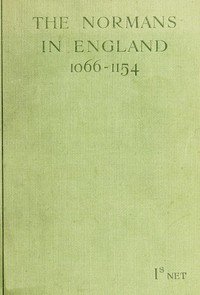
The Normans in England (1066-1154) by Bland, Bell, and Winbolt
Let's be honest, history books can sometimes feel like a list of things that happened. The Normans in England is not that kind of book. It starts with the obvious: William the Conqueror's victory at Hastings. But instead of treating that as the end of the story, the authors treat it as the explosive beginning.
The Story
The book follows the turbulent century after 1066. It shows William consolidating his power through sheer force—building castles like the Tower of London to dominate London, redistributing land to his Norman followers, and commissioning the Domesday Book, a massive survey that was less about curiosity and more about knowing exactly what he now owned and could tax. We then see the struggle continue under his sons: William Rufus, who faced constant threats to his rule, and Henry I, who had to fight his own brother to secure the throne. The period ends with the chaotic civil war known as The Anarchy, as Henry's daughter Matilda and her cousin Stephen battled for control, showing how fragile this new Norman order really was.
Why You Should Read It
What grabbed me was how the book connects big political moves to everyday life. It explains how the Norman takeover changed the English language (hello, beef and pork vs. cow and pig!), the legal system, and even the landscape with those iconic stone castles and cathedrals. It frames the Normans not as cartoon villains, but as ruthless, brilliant administrators who systematically dismantled one world to build another. You get a real sense of the tension and violence simmering beneath the surface, the constant fear of rebellion, and the political games that kept the whole shaky project afloat. It makes you see modern England in a completely different light.
Final Verdict
Perfect for anyone who's visited a Norman castle or cathedral and wondered, 'How did this get here, and what did it cost?' It's for readers who enjoy historical drama like The Last Kingdom or The Pillars of the Earth but want the real, gritty foundation those stories are built on. It's accessible enough if you only vaguely remember 1066 from school, but detailed enough to satisfy someone looking to understand the deep roots of English history. This isn't a dry chronicle; it's the story of a nation's traumatic and transformative rebirth.
This content is free to share and distribute. You can copy, modify, and distribute it freely.
Joseph Jones
1 year agoImpressive quality for a digital edition.
Nancy Moore
1 year agoI wanted to compare this perspective with traditional views, the historical context mentioned in the early chapters is quite enlightening. Simple, effective, and authoritative – what else could you ask for?
David Lopez
2 years agoThanks for the recommendation.









William Lopez
2 years agoMy first impression was quite positive because the transition between theoretical knowledge and practical application is seamless. This has become my go-to guide for this specific topic.