1

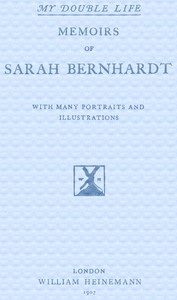
My Double Life: The Memoirs of Sarah Bernhardt — A Reader’s Guide
(0 User reviews)
105
Project Gutenberg
2005
Not confirmed
Bernhardt, Sarah, 1844-1923; Actors -- France -- Biography
Readers of public-domain and historical texts
Project Gutenberg digital edition
en
Edition facts
Words
180,308
Reading time
784 min
Text sections
44
The catalog record for My Double Life: The Memoirs of Sarah Bernhardt — A Reader’s Guide provides practical reading context through 180,308 words, 13 hr 4 min estimated reading time, and 44 detected text sections.
The text analysis averages about 17.4 words per sentence, while the detected sections provide another way to judge how the source is divided.
Project Gutenberg metadata also associates the work with “Bernhardt, Sarah, 1844-1923,” connecting these edition facts with the source record’s subject description.
Source:
Project Gutenberg record #9100
Sarah Bernhardt's memoirs reveal a performer who relished the unknown, describing letters as 'mysterious envelopes' and life as a trapeze act. The excerpts show her navigating theatre politics, a balloon trip, and a tense exchange between a marshal and a playwright.
Editorial Edition Score
4.9/5
★★★★★
★★★★★
Calculated from edition completeness, EPUB availability, text structure and catalogue metadata. Not a user rating.
How this score is calculated
- Description quality20 pts
- Title & short description10 pts
- Source metadata20 pts
- Text length15 pts
- Chapters / structure15 pts
- EPUB file integrity20 pts
Total of 100 points, scaled to a 2.5-5.0 range. Editions with an empty description or a missing EPUB file are not scored.
Edition quality
Public-domain source text
Read the source text
The source text is kept in the dedicated reader, separate from this catalogue record and its commentary.
Sarah Bernhardt opens her memoirs not with a birth date but with a metaphor: she watches letters accumulate 'just as I watch the waves of the sea,' each envelope a potential wreck or treasure. This image of poised anticipation—'I cling for a second to what is, and then I fling myself headlong into what is to be'—captures the restless energy that drives her narrative. The excerpts reveal a woman who treats life as a series of dramatic entrances and exits, from a balloon ascent to a tense luncheon where a marshal and a playwright clash over the proper steel for writing history.
Theatrical Tensions and Political Edges
In one of the memoir's most charged scenes, Bernhardt hosts a luncheon where Marshal Canrobert and the playwright William Busnach engage in a political argument that turns 'rather violent.' Busnach, described as 'the most witty and at the same time the rudest man in France,' challenges the marshal to write about 'odious Utopias.' Canrobert replies coldly: 'We do not use the same steel for writing history! You use a pen, and I a sword.' The exchange is a miniature drama of class, profession, and authority—a sword versus a pen, the old guard versus the provocateur. Bernhardt does not take sides; she records the crackle of wit and the chill of the retort, then lets the scene dissolve into 'the most delicious harmony of ideas.' The episode shows her instinct for placing herself at the center of conflicting forces without being consumed by them.
Letters, Waves, and the Unknown
Bernhardt's relationship with correspondence is almost talismanic. She receives 'quantities of letters' and delays opening them, studying envelopes for handwriting and seal. She compares the arrival of mail to the sea: 'What are they going to bring me, these mysterious envelopes, large, small, pink, blue, yellow, white? What are they going to fling upon the rock, these great wild waves, dark with seaweed? What sailor-boy’s corpse? What remains of a wreck?' The passage is one of the most lyrical in the excerpts, mixing dread and delight. She admits she never opens letters immediately, preferring to let a secretary or friend handle those whose senders she cannot identify. This ritual of hesitation and surrender—'I adore what is to be without seeking even to know about it'—mirrors her approach to career decisions, such as the moment she receives a letter from the Comédie Française and feels 'a faint tinge of pallor' instead of the flush of joy she felt a decade earlier.
The Trapeze of Decision
Bernhardt describes her characteristic response to life-altering events with a gymnastic metaphor: 'I cling for a second to what is, and then I fling myself headlong into what is to be. It is like a gymnast who clings first to his trapeze bar in order to fling himself afterwards with full force into space.' The image recurs in her account of receiving the summons from the Comédie Française. She recalls that ten years earlier, a similar envelope had made her 'flush with joy'; now she feels pallor. Yet she does not resist. The memoir suggests that her public persona—the 'Divine Sarah'—was built on a private rhythm of hesitation and leap. She admits to a 'movement of recoil' before embracing change, and she loves what is about to happen 'with tender emotion as something dead.' This psychological pattern gives the memoirs a structural pulse: each chapter ends with a decision, each beginning with a new stage.
Readers should note that these excerpts cover only the first third of a long memoir. Bernhardt's voice is consistent—wry, theatrical, self-aware—but the full work includes tours, performances, and encounters with figures like Victor Hugo and Thomas Edison. The tension between her private hesitation and public daring, visible in the trapeze metaphor and the letter ritual, offers a key to reading the entire narrative. Watch for moments when she pauses before a door, a letter, or a decision: those are the hinges of her double life.
That rainy afternoon, Bernhardt’s trapeze life—her delight in the mysterious envelope—made me ache for a quieter kind of devotion. I found myself reaching, almost without deciding, for Hugh: Memoirs of a Brother — Key Ideas to Explore, and its unhurried tenderness felt like coming inside from the storm.
There are no reviews for this eBook.
There are no comments for this eBook.
Reader reflection
Your personal reading reflection
Build a private reading journal entry for this title.
Your progress
0
/
10
2
Was reading this book enjoyable?
3
Would you encourage someone else to read it?
4
How demanding did the text feel?
5
How distinctive were its ideas or approach?
6
How personally connected did you feel to the book?
7
How useful were the ideas in this book?
8
How understandable was the text?
9
What did this book teach you most?
10