1

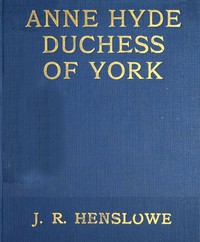
Anne Hyde, Duchess of York — Story, Setting & Ideas
(0 User reviews)
114
Project Gutenberg
2022
Not confirmed
Nobility -- Great Britain -- Biography; Great Britain -- Court and courtiers -- History -- 17th century; York, Anne Hyde, Duchess of, 1637-1671
Readers of public-domain and historical texts
Project Gutenberg digital edition
en
Edition facts
Words
67,318
Reading time
293 min
Text sections
18
Before opening Anne Hyde, Duchess of York — Story, Setting & Ideas, the edition data offers a quick orientation: 67,318 words, 4 hr 53 min estimated reading time, and 18 detected text sections.
The text analysis averages about 27.8 words per sentence, while the detected sections provide another way to judge how the source is divided.
Project Gutenberg metadata also associates the work with “Nobility -- Great Britain -- Biography,” connecting these edition facts with the source record’s subject description.
Source:
Project Gutenberg record #69499
J. R. Henslowe's 1915 biography of Anne Hyde draws on a surviving notebook to reconstruct the Duchess's voice and character, tracing her rise from commoner to royal spouse amid Restoration court intrigue.
Editorial Edition Score
4.8/5
★★★★★
★★★★★
Calculated from edition completeness, EPUB availability, text structure and catalogue metadata. Not a user rating.
How this score is calculated
- Description quality20 pts
- Title & short description10 pts
- Source metadata20 pts
- Text length15 pts
- Chapters / structure15 pts
- EPUB file integrity20 pts
Total of 100 points, scaled to a 2.5-5.0 range. Editions with an empty description or a missing EPUB file are not scored.
Edition quality
Public-domain source text
Read the source text
The source text is kept in the dedicated reader, separate from this catalogue record and its commentary.
J. R. Henslowe opens this 1915 biography with a material relic: a small, leather-bound notebook, its silver clasp broken, its gilt half worn away. This object, barely four inches by three, belonged to Anne Hyde herself. In it she jotted household lists—'3 bras candlesticks, 4 bras kittles'—and penciled French phrases that hint at a lost romance: 'Je n’en vey mourir d’amour, mais ce n’est pas pour un infidèle comme vous.' Henslowe uses this notebook as a narrative anchor, letting its faded script introduce a woman who would become Duchess of York and mother to two queens. The biography proceeds to trace her contested marriage to James, Duke of York, and her navigation of a court rife with faction and gossip.
A Voice from the Notebook
Henslowe’s most distinctive evidence is Anne’s own notebook, which he describes with precise physical detail: 'stamped leather from which the gilding is half worn away, with a broken silver clasp.' The entries are mundane—'3 bras candlesticks, 4 bras kittles, driping pans'—and intimate: 'Betty came to my Mother.' But the French sentences stand out. 'Adieu pour jamais, mais n’oubliez pas la plus misérable personne du monde' reads like a draft of heartbreak. Henslowe resists overinterpreting; he notes the uncertainty of the addressee—'Was the “infidèle” meant for Spencer Compton or Harry Jermyn?'—and the lack of dates. This restraint lets the notebook speak for itself, bridging centuries with a 'familiar touch.' The biography thus grounds its portrait not in court chronicles alone but in the material traces of a young woman’s private life.
The Marriage and Its Aftermath
Henslowe reconstructs the scandal of Anne’s marriage to James, Duke of York, through contemporary letters and council records. Lord Craven’s report to the Queen of Bohemia captures the court’s wary acceptance: 'She takes upon her as if she been duchess this seven years.' Another letter details the couple’s testimony before the Council, where they declared they were married on 3 September in a chamber at Worcester House, with only Lord Ossory and a maid present. Henslowe juxtaposes this official version with Pepys’s gossip about 'the pride of the Duchess of York,' noting the diarist’s prejudice. The narrative pace shifts here: from the notebook’s quiet introspection to the public drama of royal investigation, Henslowe shows how Anne’s private life became a matter of state, her character debated by diarists and diplomats alike.
Pace and Perspective in the Narrative
Henslowe varies his pace markedly between chapters. The opening lingers over the notebook, its pages described in slow, almost tactile detail. Later sections accelerate into a chronicle of court events—the King’s grant of £20,000 to Clarendon, Henrietta’s departure for Bourbon, the Duke’s illness. This shift mirrors the subject’s own transition from private girl to public duchess. Henslowe also weaves in multiple perspectives: James’s own defense of Anne—'Her want of birth was made up by endowments'—sits alongside Pepys’s sniping and Craven’s diplomatic praise. The effect is a layered portrait, where no single voice dominates. Readers should attend to these changes in tempo and viewpoint, as they reveal Henslowe’s method of building character from fragmentary, often contradictory sources.
Henslowe’s biography does not pretend to resolve the contradictions in Anne Hyde’s reputation. Instead, it invites readers to weigh the evidence themselves: the notebook’s penciled confessions, the council’s dry records, the diarists’ barbs. Pay particular attention to the footnotes, which cite manuscript sources such as Additional MSS. 15,900 in the British Museum. These references ground Henslowe’s narrative in archival research, reminding us that every assertion about Anne’s character rests on a document that has survived, like her notebook, by chance.
Reading about Anne Hyde’s careful self-making in that 1915 biography, I kept thinking how her private notebook must have held a very particular kind of loneliness — that feeling of carrying a self you cannot fully show. It reminded me of The Memoirs of Jacques Casanova de Seingalt, 1725-1798. Volume 04: Return to Venice — Reading Notes, where even a man so public turns inward, returning somewhere that no longer quite fits. Both felt less like history and more like quiet echoes.
There are no reviews for this eBook.
There are no comments for this eBook.
Reader reflection
Your personal reading reflection
Build a private reading journal entry for this title.
Your progress
0
/
10
2
How did the book work for you overall?
3
Would you encourage someone else to read it?
4
How much effort did this book require?
5
Did any part of the book feel personally relevant?
6
How much did the book move you?
7
How valuable was this book for your own interests?
8
How clearly were the main ideas presented?
9
Which lesson or insight stayed with you?
10