1

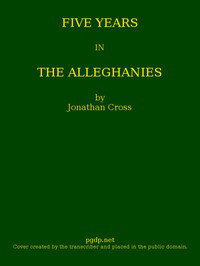
Five Years in the Alleghanies — Text and Context
(0 User reviews)
71
Project Gutenberg
2016
Not confirmed
Evangelists -- United States -- Biography; Missions -- Appalachian Region; Cross, Jonathan
Readers of public-domain and historical texts
Project Gutenberg digital edition
en
Edition facts
Words
43,192
Reading time
188 min
Text sections
4
Five Years in the Alleghanies — Text and Context can be approached with a clearer sense of reading commitment from its source measurements: 43,192 words, 3 hr 8 min estimated reading time, and 4 detected text sections.
The text analysis averages about 19.9 words per sentence, while the detected sections provide another way to judge how the source is divided.
Project Gutenberg metadata also associates the work with “Evangelists -- United States -- Biography,” connecting these edition facts with the source record’s subject description.
Source:
Project Gutenberg record #52697
Jonathan Cross's memoir recounts his five years as a colporteur in the Alleghany Mountains, detailing encounters with rough settlers, violent bullies, and isolated communities, and the transformative power of religious tracts and preaching in a lawless frontier.
Editorial Edition Score
4.6/5
★★★★★
★★★★★
Calculated from edition completeness, EPUB availability, text structure and catalogue metadata. Not a user rating.
How this score is calculated
- Description quality20 pts
- Title & short description10 pts
- Source metadata20 pts
- Text length15 pts
- Chapters / structure15 pts
- EPUB file integrity20 pts
Total of 100 points, scaled to a 2.5-5.0 range. Editions with an empty description or a missing EPUB file are not scored.
Edition quality
Public-domain source text
Read the source text
The source text is kept in the dedicated reader, separate from this catalogue record and its commentary.
Jonathan Cross opens his memoir with a stark confession: he was born on the border of Western Pennsylvania and Virginia, where the howl of wolves, the scream of panthers, and the Indian's tomahawk were his childhood dreads. This personal history grounds his account of five years spent as a colporteur—a distributor of religious books and tracts—in the Alleghany Mountains. The narrative is built around a series of encounters with isolated settlers, many of whom are hostile, superstitious, or deeply entrenched in violent habits. Cross does not present himself as a heroic figure; instead, he records the slow, often surprising changes that occur when a printed page or a spoken sermon breaks through suspicion.
Violence and Conversion in the Backwoods
The excerpts reveal a pattern: the most formidable characters in Cross's account are those who have built reputations on physical strength and lawlessness. One man, known as Father B——, was a notorious bully who could whip any man in the county; he even decided the location of a courthouse by a fistfight. Yet a single tract, 'The Fool's Pence,' given to him by a judge, led to his conversion and a subsequent fifteen-year career as a successful preacher. Cross does not explain how this transformation occurred, but he presents it as a matter of record, testified to by another speaker at a meeting. The narrative thus juxtaposes raw frontier violence with the sudden, unexplained power of printed words to redirect a life.
The Sabbath Shooting Match
One of the most vivid episodes involves a colporteur who arrives in a settlement where Sunday is the day for frolicking and dissipation. Lodging with a family preparing for a shooting-match, he decides to join them rather than protest. At the gathering, he prays aloud and then preaches, and the crowd—initially confounded—listens in silence. He distributes his remaining books and tracts, and soon afterward, news spreads that people in that region are concerned about their souls. Within a short time, a preacher gathers a congregation and over twenty converts, and Sunday frolicking ceases. Cross's account here emphasizes the colporteur's willingness to meet people on their own ground, even at a gambling event, and the unexpected receptivity that follows.
A Colloquial Record of Frontier Religion
Cross's prose is direct and unadorned, often reproducing the words of the people he meets. The excerpts include a man's testimony about reading a tract on the word 'Eternity' until he had it committed to memory, then building a church on his land within six months. Another speaker recalls a judge's stern lecture to a bully, complete with the phrase 'you have become too bad a man to live.' These embedded voices give the memoir a documentary quality, as if Cross is compiling evidence rather than crafting a polished narrative. The chapter titles—'The grog-shop—The rolling mills—The Universalist,' 'The pistol—The surveyor's son'—further suggest a catalog of encounters, each one a case study in the collision of religious conviction with frontier life.
Readers approaching Five Years in the Alleghanies should expect a series of discrete episodes rather than a continuous story. Cross's method is to let the incidents speak for themselves, often without explicit moralizing. The book rewards attention to the details of setting—the isolated farms, the court-house fights, the Sabbath shooting-matches—and to the precise wording of the testimonies he records. It is a work that documents, without sentimentality, the slow and uneven spread of religious influence in a region where law and order were still being established.
I recall how Mr. Cross trudged those rough mountain trails with his little books, and I thought of Lady Fanshawe, keeping her own quiet record through upheaval and exile. Both understood that a single voice, set down patiently, can hold a world together when everything outside is chaos. There is a kinship in that—in the Memoirs of Lady Fanshawe Wife of Sir Richard Fanshawe, Bt., Ambassador from Charles II to the Courts of Portugal and Madrid. — Text and Context remembering what the Alleghanies taught me.
There are no reviews for this eBook.
There are no comments for this eBook.
Reader reflection
How did this book work for you?
Your answers remain private and are stored only in this browser.
Your progress
0
/
10
2
How did the book work for you overall?
3
How likely are you to recommend this book?
4
How easy was the book to follow?
5
Would you like to discuss this book with someone?
6
How clearly were the main ideas presented?
7
How would you rate its originality?
8
Would a second reading be valuable?
9
What did this book teach you most?
10