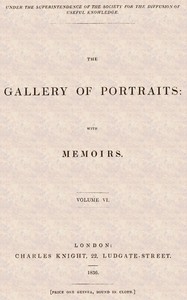
The Gallery of Portraits: with Memoirs. Volume 6 (of 7) — Edition Insights

(5 User reviews)   1245
In Category - Memoirs
Malkin, Arthur Thomas Project Gutenberg 2017 Not confirmed
Biography Readers of public-domain and historical texts
Project Gutenberg digital edition en

Edition facts

Words 81,671
Reading time 356 min
Text sections 26

Before opening The Gallery of Portraits: with Memoirs. Volume 6 (of 7) — Edition Insights, the edition data offers a quick orientation: 81,671 words, 5 hr 56 min estimated reading time, and 26 detected text sections.

The text analysis averages about 28.1 words per sentence, while the detected sections provide another way to judge how the source is divided.

Project Gutenberg metadata also associates the work with “Biography,” connecting these edition facts with the source record’s subject description.

Observations on how Arthur Thomas Malkin's biographical sketches in Volume 6 of 'The Gallery of Portraits' balance documented fact with interpretive commentary, using the entries on Raleigh and Wesley as case studies.
Share
Editorial Edition Score 4.9/5

Calculated from edition completeness, EPUB availability, text structure and catalogue metadata. Not a user rating.

How this score is calculated
  • Description quality20 pts
  • Title & short description10 pts
  • Source metadata20 pts
  • Text length15 pts
  • Chapters / structure15 pts
  • EPUB file integrity20 pts

Total of 100 points, scaled to a 2.5-5.0 range. Editions with an empty description or a missing EPUB file are not scored.

Edition quality

Read the Text

alter himself of being privy to a conspiracy against the government. This charge Cobham retracted, confirmed, and retracted again, behaving in so equivocal a manner, that no reliance whatever can be placed on any of his assertions. But as the King was afraid of Raleigh as much as the secretary hated him, this vague charge, unsupported by other evidence, was made sufficient to commit him to the Tower; and, after being plied with private examinations, in which nothing criminal could be elicited, he was brought to trial, November 17, 1603. For an account of that memorable scene we shall refer to Mr. Jardine’s ‘Criminal Trials,’ vol. i. It is reported to have been said by one of the judges who presided over it, on his death-bed, that “the justice of England had never been so degraded and injured as by the condemnation of Sir Walter Raleigh.” The behaviour of the victim himself was the object of universal admiration, for the tempered mixture of patience and noble spirit with which he bore the oppressive measure dealt to him. He had before been unpopular; but it was recorded by an eye-witness that “he behaved himself so worthily, so wisely, and so temperately, that in half a day the mind of all the company was changed from the extremest hate to the extremest pity.”

Arthur Thomas Malkin's biographical method in The Gallery of Portraits: with Memoirs (Volume 6) is neither a dry recitation of facts nor a hagiographic tribute. Instead, the entries blend documented events with interpretive commentary, often revealing the author's own judgments about his subjects. This editorial note examines how Malkin handles two figures—Sir Walter Raleigh and John Wesley—to illustrate the work's characteristic tension between evidence and inference.

Raleigh: From Precocious Youth to Speculative Ventures

Malkin opens the Raleigh entry with a cautious admission: “Very little is known concerning the youth of Sir Walter Raleigh.” He then proceeds to cite specific details—birth at Hayes farm in 1552, attendance at Oriel College, service as a volunteer in France and the Netherlands—but frequently qualifies his statements with phrases like “it is conjectured” or “it is probable.” This restraint is notable when describing Raleigh’s introduction to Queen Elizabeth, which Malkin calls “traditionally reported” and “too familiar to need repetition.” The author thus signals that he is relying on received tradition rather than primary evidence.

Yet Malkin does not merely compile facts. He interprets Raleigh’s early career as a product of “natural aptitude for political and military science” nurtured by leaders like Coligni and the Prince of Orange. The pursuit of New World discovery is described as having “captivated his imagination from an early age.” These interpretive leaps are grounded in the sequence of events Malkin lays out, but they also reflect his own view of Raleigh as a figure shaped by ambition and opportunity.

Wesley’s Conversion and the Ambiguities of Founding a Movement

The Wesley entry offers a more complex interplay of fact and interpretation. Malkin recounts Wesley’s conversion experience with direct quotation: “I was striving, yea fighting, with all my might under the law, as well as under grace; but then I was sometimes, if not often, conquered; now I am always conqueror.” He then notes that Wesley “scrupled not to proclaim” that he had never been a Christian before that moment. The author’s own stance emerges in the careful phrasing: he calls the conversion “justly considered as a remarkable day in the history of methodism,” but does not endorse Wesley’s self-assessment.

Malkin’s analysis of Wesley’s visit to the Moravian colony at Herrnhut is similarly layered. He reports Wesley’s own words—“I would gladly have spent my life here; but my Master calling me to labour in another part of the vineyard”—but immediately adds that Wesley “perceived clearly enough the imperfections in their method.” The author then speculates about Wesley’s intentions: “His scheme, if indeed he had then proposed to himself any fixed scheme, was rather to awaken the spirit of religion slumbering within the Church.” This hedging reveals Malkin’s awareness that he is reconstructing motives from incomplete evidence.

The Biographer’s Voice: Judgment and Restraint

Across both entries, Malkin employs a consistent rhetorical strategy: he presents facts, then offers interpretation, but often signals the limits of his knowledge. For Raleigh, he uses phrases like “it is conjectured” and “it is probable”; for Wesley, he inserts parenthetical doubts such as “if indeed he had then proposed to himself any fixed scheme.” This pattern suggests a biographer who is aware of the gap between what can be documented and what must be inferred.

Malkin also does not shy away from evaluative language. He describes Raleigh’s half-brother Sir Humphrey Gilbert as “a man of courage and ability, and a skilful sailor.” Wesley’s field-preaching is called “the first indication of any approach to a separation from the Church.” These judgments are woven into the narrative rather than isolated in a concluding assessment. The result is a series of portraits that feel both informative and opinionated, yet remain tethered to the available record.

Readers of Volume 6 should attend to the ways Malkin signals certainty versus speculation. His use of qualifiers, direct quotations, and interpretive asides reveals a biographer who is both a compiler and a critic. The entries reward close reading not only for their content but for their method—a method that balances the demands of factual accuracy with the desire to make historical figures vivid and meaningful.

In the hushed margins of Malkin’s portraits, I often ponder the quiet arithmetic of a life—how a single choice echoes for decades. It reminds me of the weathered honesty found in The Military Sketch-Book. Vol. 1 (of 2) Reminiscences of seventeen years in the service abroad and at home — Reading Companion, where time itself seems to whittle a man down to his essential truths, a kinship of patience shared between the lines.

Aria Campbell
2 weeks ago

Grayson Nelson
1 month ago

Victoria Allen
1 month ago

Matthew Jones
4 weeks ago

Aria Lopez
2 weeks ago

5
5 out of 5 (5 User reviews )

Add a Review

Your Rating *
There are no comments for this eBook.

Reader reflection

How did this book work for you?

Your answers remain private and are stored only in this browser.

Your progress 0 / 10
1

Have you finished this book?

2

How much did you enjoy the reading experience?

3

Is this a title you would suggest to others?

4

How easy was the book to follow?

Related eBooks