1

Brief Lives, Vol. 1 — Themes and Context
(0 User reviews)
307
Project Gutenberg
2014
Not confirmed
Great Britain -- Biography; Great Britain -- History -- Stuarts, 1603-1714 -- Biography; Great Britain -- History -- Charles II, 1660-1685 -- Biography; Great Britain -- History -- Tudors, 1485-1603 -- Biography
Readers of public-domain and historical texts
Project Gutenberg digital edition
en
Edition facts
Words
146,968
Reading time
639 min
Text sections
231
For Brief Lives, Vol. 1 — Themes and Context, the stored edition analysis reports 146,968 words, 10 hr 39 min estimated reading time, and 231 detected text sections.
The text analysis averages about 13.5 words per sentence, while the detected sections provide another way to judge how the source is divided.
Project Gutenberg metadata also associates the work with “Great Britain -- Biography,” connecting these edition facts with the source record’s subject description.
Source:
Project Gutenberg record #47787
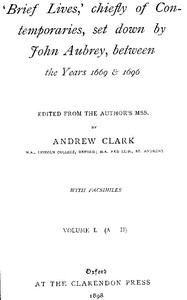
John Aubrey's 17th-century biographical sketches, edited by Andrew Clark, capture the lives of contemporaries with candid, often idiosyncratic detail. This volume (A-H) reveals the tensions between memory and fact, personal bias and historical record, through Aubrey's distinctive voice and editorial annotations.
Editorial Edition Score
4.9/5
★★★★★
★★★★★
Calculated from edition completeness, EPUB availability, text structure and catalogue metadata. Not a user rating.
How this score is calculated
- Description quality20 pts
- Title & short description10 pts
- Source metadata20 pts
- Text length15 pts
- Chapters / structure15 pts
- EPUB file integrity20 pts
Total of 100 points, scaled to a 2.5-5.0 range. Editions with an empty description or a missing EPUB file are not scored.
Edition quality
Public-domain source text
Read the source text
The source text is kept in the dedicated reader, separate from this catalogue record and its commentary.
John Aubrey's Brief Lives are not tidy biographies. They are jotted observations, hearsay, and sharp character notes set down between 1669 and 1696. This first volume, edited by Andrew Clark, covers names from Abbot to Hyde. The editor warns that Aubrey's quotations are 'plainly cited from memory, not from book' and 'frequently do not scan'. The text thus preserves a deliberate roughness—a record of how one man remembered his contemporaries, with all the gaps and slants that entails.
Memory as Method
Aubrey's method is associative, not systematic. He records what struck him, often in fragments. The editor notes that Aubrey's Latin quotations 'do not even construe' and are sometimes 'incorrect cementings of odd half lines'. This is not carelessness but a feature of the work: Aubrey writes as he remembers, trusting his ear over the page. The result is a texture of lived recollection, where a single life may include a horoscope, a military treatise, or a family feud. The reader encounters not a polished portrait but a collection of traces—what one person found worth preserving about another.
The Editor's Interference
Andrew Clark's editorial presence is felt throughout. He states that 'the rules laid down for this edition have been fully stated in the Introduction' and that they have been 'scrupulously followed'. He also notes necessary excisions, particularly around Sir Walter Raleigh and the Herbert family, where Aubrey's 'nasty' remarks or 'coarse stories' required trimming. Clark speculates on personal pique or a Wiltshire 'feud' behind Aubrey's bias. This editorial layer adds a second tension: the reader sees not only Aubrey's slant but also Clark's corrections, creating a dialogue between seventeenth-century gossip and nineteenth-century scholarly propriety.
Patterns of Prejudice and Precision
Certain patterns recur. Aubrey is 'generally nasty' about the Herbert and Sydney families, and Clark suggests a near-assassination by a Herbert as possible cause. Yet alongside these biases, Aubrey includes precise details: a book's dedication, a muster-master's title, a mathematical treatise's full Latin title. The entry on Thomas Digges, for instance, quotes at length from his Alae seu scalae mathematicae and notes a family of 'four learned men in an uninterrupted descent'. The juxtaposition of gossip and technical citation is characteristic. Aubrey's Brief Lives are thus a mosaic of the trivial and the technical, held together by a single observer's curiosity.
Readers should approach this volume as a primary document of how one seventeenth-century gentleman compiled and judged his contemporaries. The editor's notes are essential for distinguishing Aubrey's voice from Clark's. Pay attention to what is included—a horoscope, a book title, a rumor—and what is omitted. The Brief Lives reward those who read between the lines, watching for the tensions between memory, malice, and the desire to record.
I keep thinking about how Aubrey’s sketches feel less like facts and more like whispered memories, half-true but so alive. That same tenderness for the imperfect past lingers in The Life and Reign of Edward I. — Edition Insights, where the weight of a reign softens into something almost personal. It stayed with me quietly, like an old photograph found by chance.
There are no reviews for this eBook.
There are no comments for this eBook.
Reader reflection
Record your reading impressions
A brief reflection can help important ideas stay with you longer.
Your progress
0
/
10
2
How much did you enjoy the reading experience?
3
Would you recommend this book to another reader?
4
How easy was the book to follow?
5
Was the book moving at the right speed?
6
Did you gain anything practical from the text?
7
Did any part of the book feel personally relevant?
8
Did this book create an emotional response?
9
What did this book teach you most?
10