1

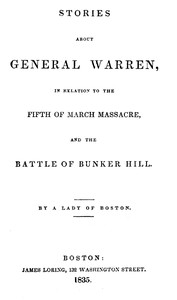
Stories about General Warren, in relation to the fifth of March massacre, and the battle of Bunker Hill — Key Ideas to Explore
(0 User reviews)
387
Project Gutenberg
2014
Not confirmed
Generals -- United States -- Biography; Warren, Joseph, 1741-1775; Bunker Hill, Battle of, Boston, Mass., 1775; Boston Massacre, 1770
Readers of public-domain and historical texts
Project Gutenberg digital edition
en
Edition facts
Words
23,947
Reading time
105 min
Text sections
3
Before opening Stories about General Warren, in relation to the fifth of March massacre, and the battle of Bunker Hill — Key Ideas to Explore, the edition data offers a quick orientation: 23,947 words, 1 hr 45 min estimated reading time, and 3 detected text sections.
The text analysis averages about 24.1 words per sentence, while the detected sections provide another way to judge how the source is divided.
Project Gutenberg metadata also associates the work with “Generals -- United States -- Biography,” connecting these edition facts with the source record’s subject description.
Source:
Project Gutenberg record #47044
Rebecca Warren Brown's 1835 biography uses conversational dialogue and a mother-son framing to recount Joseph Warren's role in the Boston Massacre and Bunker Hill, emphasizing his long-standing patriotism through specific word choices and narrative structure.
Editorial Edition Score
4.5/5
★★★★★
★★★★★
Calculated from edition completeness, EPUB availability, text structure and catalogue metadata. Not a user rating.
How this score is calculated
- Description quality20 pts
- Title & short description10 pts
- Source metadata20 pts
- Text length15 pts
- Chapters / structure15 pts
- EPUB file integrity20 pts
Total of 100 points, scaled to a 2.5-5.0 range. Editions with an empty description or a missing EPUB file are not scored.
Edition quality
Public-domain source text
Read the source text
The source text is kept in the dedicated reader, separate from this catalogue record and its commentary.
Rebecca Warren Brown, publishing under the byline "A Lady of Boston," opens her 1835 biography of Joseph Warren with a domestic scene: Mary Montague and her mother sit sewing by a fire when nine-year-old William complains of tiredness from playing hoop. This framing device, sustained through the excerpts, filters revolutionary history through a mother’s instructive conversations with her children. Brown’s preface declares her intent to answer the question "What did Gen. Warren do?" by showing his years of toil before bloodshed, and her diction throughout—words like "hazardous duty" and "last drop of blood"—repeatedly ties personal sacrifice to national freedom.
Dialogue as a Vehicle for Character
Brown relies heavily on direct speech to dramatize Warren’s resolve. When his mother pleads with him after Lexington, he replies, "Wherever danger is, dear mother, there must your son be." The line echoes a refrain of duty that appears again at Bunker Hill, where Warren tells Putnam, "Do not think I come here to seek a place of safety." These utterances are not merely reported; they are staged as moral declarations. The author’s choice to embed Warren’s words within a conversational frame—often as responses to anxious family members or fellow officers—emphasizes his consistency under pressure. The dialogue is spare, avoiding ornament, and each speech acts as a miniature argument for principled action.
The Mother-Child Frame as Historical Lens
The narrative is structured around Mrs. Montague’s explanations to William and Mary, a device that allows Brown to simplify complex political causes. When William tires of play, his mother turns the moment into a lesson on industry versus idleness. Later, she recounts Warren’s story as a model of perseverance. This framing does more than target a young audience; it positions domestic instruction as the conduit for civic memory. Brown’s preface explicitly aims to place "the leading causes of the Revolution in so strong and clear a light" that a child can comprehend them. The result is a biography where historical events are always mediated through a maternal voice, blending sentiment with didactic purpose.
Diction of Sacrifice and Steadfastness
Brown’s word choices consistently reinforce a theme of voluntary sacrifice. Warren tells his mother he will "shed my last drop of blood to make her so" (referring to America’s freedom). At the redoubt, he refuses command and offers himself as a volunteer, saying he is "happy to learn service from a soldier of experience." The vocabulary—"hazardous," "sacrifice," "last drop," "most furious"—creates a lexicon of martyrdom. Even the British are described in terms of their "handsome coats," a detail that subtly contrasts appearance with substance. Brown avoids abstract praise; instead, she lets Warren’s own reported words and the narrator’s restrained commentary build a portrait of deliberate courage.
Structural Pacing and the Battle Account
The Bunker Hill section shifts from domestic dialogue to a more urgent, scene-by-scene military narrative. Brown describes the rail fence fortified with new-mown hay, the order to "fire low, take aim at their waistbands," and Putnam’s threat to cut down any man who fires early. The prose becomes more compressed, with short clauses: "The command was given, they fired, and nearly the whole front rank of the advancing army was destroyed." This change in rhythm—from the measured exchanges of the Montague household to the rapid, almost breathless battle sequence—mirrors the transition from peacetime deliberation to wartime action. The author uses pacing to underscore that Warren’s final moments are the culmination of years of patient toil.
Brown’s biography is best approached as a deliberate act of historical pedagogy, one that uses intimate dialogue and a mother’s voice to make revolutionary ideals tangible. Readers attentive to the author’s choices in diction and structure will notice how she transforms Warren from a name into a model of sustained patriotism. The book rewards those who consider not just what Warren did, but how Brown chose to tell it—through conversations that turn duty into a lesson for the next generation.
I keep returning to how Rebecca Warren Brown frames her son’s questions, that quiet persistence of a mother’s memory. It reminds me of an old companion volume I once leafed through, Peter Parley's Own Story From the Personal Narrative of the Late Samuel G. Goodrich, ("Peter Parley") — Key Ideas to Explore, whose gentle conversational tone felt similarly unhurried, as if history were just a fireside murmur.
There are no reviews for this eBook.
There are no comments for this eBook.
Reader reflection
What was your reading experience?
Capture what you thought, learned, and would like to remember.
Your progress
0
/
10
2
How did the book work for you overall?
3
Would you pass this book on to a friend?
4
How easy was the book to follow?
5
Would this book work well in a reading group?
6
Was the book moving at the right speed?
7
What was the strongest part of the book?
8
Did the book deliver what you hoped for?
9
Which lesson or insight stayed with you?
10