1

Lady Byron Vindicated: A History of the Byron Controversy — A Closer Reading
(0 User reviews)
287
Project Gutenberg
2014
Not confirmed
Poets, English -- 19th century -- Biography; Byron, Anne Isabella (Milbanke) Byron, Baroness, 1792-1860; Byron, George Gordon Byron, Baron, 1788-1824 -- Marriage; Authors' spouses -- Great Britain -- Biography
Readers of public-domain and historical texts
Project Gutenberg digital edition
en
Edition facts
Words
103,149
Reading time
449 min
Text sections
13
Lady Byron Vindicated: A History of the Byron Controversy — A Closer Reading can be approached with a clearer sense of reading commitment from its source measurements: 103,149 words, 7 hr 29 min estimated reading time, and 13 detected text sections.
The text analysis averages about 26.4 words per sentence, while the detected sections provide another way to judge how the source is divided.
Project Gutenberg metadata also associates the work with “Poets, English -- 19th century -- Biography,” connecting these edition facts with the source record’s subject description.
Source:
Project Gutenberg record #44791
Harriet Beecher Stowe's 1870 defense of Lady Byron against accusations, drawing on personal acquaintance and published letters to argue that Lord Byron's erratic behavior and claims of incest were symptoms of insanity.
Editorial Edition Score
4.8/5
★★★★★
★★★★★
Calculated from edition completeness, EPUB availability, text structure and catalogue metadata. Not a user rating.
How this score is calculated
- Description quality20 pts
- Title & short description10 pts
- Source metadata20 pts
- Text length15 pts
- Chapters / structure15 pts
- EPUB file integrity20 pts
Total of 100 points, scaled to a 2.5-5.0 range. Editions with an empty description or a missing EPUB file are not scored.
Edition quality
Public-domain source text
Read the source text
The source text is kept in the dedicated reader, separate from this catalogue record and its commentary.
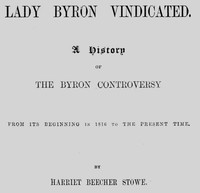
Harriet Beecher Stowe opens Lady Byron Vindicated by framing the work as a direct reply to the storm of criticism that followed her earlier article, “The True Story of Lady Byron’s Life.” The book’s title page and publisher’s note immediately establish its defensive posture: Stowe is portrayed as acting from “an intense love of justice and hatred of oppression,” and the publishers state they undertook the project at her request, as friends, to counter what they call “grave injustice” and “maliciousness” from critics. The structure is forensic, dividing the controversy into three parts: a history of the attacks on Lady Byron, Stowe’s personal testimony, and a collection of supporting documents.
A Controversy Built on Letters and Timing
Stowe’s argument relies heavily on the dating and interpretation of correspondence. She scrutinizes a letter from Lady Byron to Mrs. Leigh, noting it lacks a date and is written in a style uncharacteristically “not in Lady Byron’s usual clear and elegant style.” This deviation, Stowe suggests, must be judged by the “peculiar and distressing circumstances” of the moment. She uses this letter to place the reader inside Lady Byron’s state of mind during her confinement, when she clung to her sister-in-law’s presence as a refuge. The absence of a date becomes a point of evidence: without it, Stowe argues, the letter’s meaning must be inferred from its internal emotional tone rather than external chronology. This method—treating a missing date as significant—typifies Stowe’s approach throughout, where gaps in the record are read as clues to suppressed truths.
The Insanity Defense and Its Narrative Function
Central to Stowe’s vindication is the claim that Lord Byron deliberately tried to convince his wife of “improper relations subsisting between himself and his sister.” Stowe presents this as a “startling scene” that desolated Lady Byron by tearing away “the last hold of friendship.” The only relief, Stowe writes, came when Mrs. Leigh convinced Lady Byron that the whole episode was attributable to insanity—a conviction “gladly accepted.” Stowe does not assert that Byron was insane; rather, she shows how the insanity explanation served as a necessary narrative device for Lady Byron to preserve her own sanity and social position. The text thus reveals a double layer: Byron’s alleged misconduct and the strategic interpretation of it as madness. Stowe’s own voice remains carefully non-committal, reporting the explanation without endorsing it as fact.
Evidence of Character Through Contrasting Witnesses
Stowe structures part of her argument around a direct comparison of the two principal witnesses: Lady Byron and Lord Byron. She draws on published accounts—Moore’s biography and Lady Blessington’s Conversations—to illustrate Byron’s volatility. One anecdote describes Byron destroying a favorite watch “in a fit of vexation and rage” by grinding it to pieces with a poker. Stowe uses such details to build a portrait of a man prone to “unaccountable” behavior, implicitly contrasting this with Lady Byron’s documented restraint. The excerpts show Stowe weaving together third-party testimony (Moore, Blessington) with Lady Byron’s own letters, creating a mosaic of evidence that asks the reader to judge character through accumulation of incident rather than direct assertion. This method reflects Stowe’s broader strategy: she rarely states her conclusions outright, instead arranging facts so that they seem to speak for themselves.
Readers approaching Lady Byron Vindicated should attend to how Stowe manages tone: she writes as a partisan but rarely raises her voice, preferring the weight of documented detail. The book’s three-part structure—history, personal testimony, documents—invites cross-referencing. Notice how Stowe handles the problem of incomplete evidence: she often flags what is missing (dates, contexts, alternative accounts) and turns those gaps into arguments. The work is less a biography than a legal brief, and its persuasiveness depends on the reader’s willingness to follow its chain of inference.
There's something tender in how Harriet Beecher Stowe insisted on telling Lady Byron's truth, even when the world preferred its scandal. It reminds me of how quietly she championed another Harriet’s story, finding strength in uncelebrated persistence. That same steady regard for unseen courage lingers in Scenes in the Life of Harriet Tubman — Background and Themes, like a lamp left burning for the next reader who needs it.
There are no reviews for this eBook.
There are no comments for this eBook.
Reader reflection
What did you think of this book?
Answer a few questions and save a private reflection on this device.
Your progress
0
/
10
2
How did the book work for you overall?
3
Would you pass this book on to a friend?
4
How easy was the book to follow?
5
Would you start a conversation about this book?
6
Was the book what you thought it would be?
7
Which part made the strongest impression?
8
Was the book moving at the right speed?
9
What did this book teach you most?
10