1

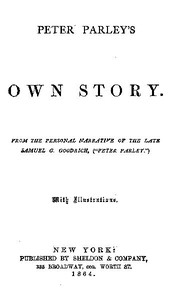
Peter Parley's Own Story From the Personal Narrative of the Late Samuel G. Goodrich, ("Peter Parley") — Key Ideas to Explore
(0 User reviews)
96
Project Gutenberg
2014
Not confirmed
Historians -- United States -- Biography; Authors, American -- 19th century -- Biography; Goodrich, Samuel G. (Samuel Griswold), 1793-1860; Ridgefield (Conn. : Town)
Readers of public-domain and historical texts
Project Gutenberg digital edition
en
Edition facts
Words
90,781
Reading time
395 min
Text sections
9
Before opening Peter Parley's Own Story From the Personal Narrative of the Late Samuel G. Goodrich, ("Peter Parley") — Key Ideas to Explore, the edition data offers a quick orientation: 90,781 words, 6 hr 35 min estimated reading time, and 9 detected text sections.
The text analysis averages about 21.5 words per sentence, while the detected sections provide another way to judge how the source is divided.
Project Gutenberg metadata also associates the work with “Historians -- United States -- Biography,” connecting these edition facts with the source record’s subject description.
Source:
Project Gutenberg record #45165
Samuel G. Goodrich, writing as Peter Parley, recounts his Connecticut childhood and editorial career through vivid, anecdotal scenes. The narrative dwells on local character sketches, domestic economy, and the author's own procrastination, revealing a self-aware memoirist who treats memory as a series of sharply observed vignettes rather than a continuous arc.
Editorial Edition Score
4.8/5
★★★★★
★★★★★
Calculated from edition completeness, EPUB availability, text structure and catalogue metadata. Not a user rating.
How this score is calculated
- Description quality20 pts
- Title & short description10 pts
- Source metadata20 pts
- Text length15 pts
- Chapters / structure15 pts
- EPUB file integrity20 pts
Total of 100 points, scaled to a 2.5-5.0 range. Editions with an empty description or a missing EPUB file are not scored.
Edition quality
Public-domain source text
Read the source text
The source text is kept in the dedicated reader, separate from this catalogue record and its commentary.
Samuel G. Goodrich, better known by his pen name Peter Parley, opens his personal narrative not with a sweeping declaration but with a precise inventory of his birthplace: the old house in Ridgefield, the meeting-house, Parson Mead, and Keeler's Tavern with its embedded cannon-ball. This attention to material detail—a spy-glass, a shovel, a black patch in the road—announces a memoirist who trusts the evocative power of objects and places over abstract reflection. The excerpts reveal a writer who arranges his past as a series of discrete, almost ethnographic sketches: the chimney-corner courtships, the festival of the quilts, the travelling artisans who brought news and goods to a self-sufficient community. Goodrich's voice is that of a collector of curiosities, and his own story becomes a cabinet of New England life at the turn of the nineteenth century.
The Texture of Daily Life
Goodrich devotes several chapters to the habits, costume, amusements, and domestic economy of Ridgefield society. He catalogs trades and professions, describes dram-drinking and family products, and notes the role of clerical patronage in raising a church. The prose is thick with specific nouns—Molly Gregory and church music, the retired tailor and his farm—that ground the narrative in a world where a man's worth might be measured by his skill at whittling. One anecdote tells of a father who refused his daughter's suitor because the young man "whittles and whittles, and never makes nothing!" This concern with productive versus idle handiwork recurs throughout the excerpts, suggesting that Goodrich sees character expressed in the smallest manual acts.
The Editor at Work and at Play
A remarkable passage describes a week in which the editor Brainard—and by extension Goodrich himself—struggles to write. He reads Byron, pores over a Waverly novel, visits friends, and delays until the last moment. When he finally reaches his office, he falls into a "curious train of reflections, half comic and half serious," wishing he were a slave so that responsibility would be lifted from him. "After all," he muses, "liberty is the greatest possible slavery." The scene is rendered with novelistic immediacy: the dim fire, the small Franklin stove, the boy who demands copy, the scrap of coarse paper on which Brainard scribbles "The Falls of Niagara." Goodrich presents authorship not as inspiration but as a grim, comic negotiation with obligation.
Voices and Characters
The excerpts are populated by figures who speak in distinctive cadences. There is Mat Olmstead, the town wit; Lieutenant Smith; Granther Baldwin and his wife; Sarah Bishop and her cave. Goodrich does not simply name them but allows them to emerge through reported speech and anecdote. The dialogue attributed to Brainard—"Would to Heaven," he says, "I were a slave!"—is rendered with a droll mixture of fun and despair that feels authentic. Even the minor characters, like the boy with a "touselled head and inky countenance," are given a single line of curt dialogue: "Copy, Mr. Brainard!" These voices, preserved in the amber of Goodrich's memory, give the narrative a choral quality, as if the past speaks through many mouths.
Objects as Anchors
Throughout the excerpts, physical objects serve as prompts for memory and reflection. The old house, the meeting-house, the cannon-ball at Keeler's Tavern, the spy-glass, the shovel, the black patch in the road—each is a node around which a story gathers. Goodrich describes Brainard's table as "hacked along edges with many a restless penknife," and this image of accumulated, idle carving becomes a metaphor for the writer's own method: he whittles at memory, shaping it into anecdote. The narrative itself is a kind of whittling—a patient, repetitive shaping of raw experience into something that, if not always useful, is at least telling. The reader is invited to see the world through these notched surfaces.
The Self as Subject and Object
Goodrich's narrative stance is that of a man observing his own younger self with a mixture of affection and irony. He does not claim heroic consistency; instead, he presents himself as a creature of impulse and delay, subject to colds, procrastination, and the lure of a rocking chair by the fire. The passage in which he accompanies Brainard to the office is written in the first person but with a curious detachment: "As was not uncommon, I go with him." This doubling—the older narrator shadowing the younger man—creates a subtle tension between the self who acted and the self who remembers. The memoir becomes a dialogue between these two figures, each regarding the other with a knowing, half-amused eye.
Readers approaching Peter Parley's Own Story should expect not a continuous autobiography but a mosaic of scenes, each polished to a hard, clear surface. Goodrich's method is associative rather than chronological; he follows the grain of memory rather than the line of a timeline. The pleasure of the text lies in its particulars—the taste of a grandmother's Indian pudding, the feel of a spy-glass, the sound of a parson's laugh. To read it is to sit beside the author as he turns over the relics of his past, holding each one up to the light.
I keep thinking about how Parley lingers over small moments—the household economy, a neighbor’s odd habit—without rushing to a moral. It’s the same quietness I felt reading The Life and Labors of Elias Hicks — Context and Discussion, where a life unfolds in deliberate, unhurried details rather than grand arcs. Some memories just sit with you, like a porch step in late afternoon.
There are no reviews for this eBook.
There are no comments for this eBook.
Reader reflection
How will you remember this book?
Save your reaction, strongest insight, and memorable passage.
Your progress
0
/
10
2
What was your overall reaction to the book?
3
Would you pass this book on to a friend?
4
Did the language feel accessible?
5
Could you follow the author’s main argument?
6
How would you describe its reading pace?
7
Did the book give you something worth debating?
8
How would you rate its originality?
9
What changed or sharpened your thinking?
10