1

Elijah Cobb — A Reader’s Guide
(0 User reviews)
329
Project Gutenberg
2023
Not confirmed
Cobb, Elijah, 1768-1848; Ship captains -- Massachusetts -- Biography; United States -- History -- 1783-1815
Readers of public-domain and historical texts
Project Gutenberg digital edition
en
Edition facts
Words
28,747
Reading time
125 min
Text sections
9
The catalog record for Elijah Cobb — A Reader’s Guide provides practical reading context through 28,747 words, 2 hr 5 min estimated reading time, and 9 detected text sections.
The text analysis averages about 34.2 words per sentence, while the detected sections provide another way to judge how the source is divided.
Project Gutenberg metadata also associates the work with “Cobb, Elijah, 1768-1848,” connecting these edition facts with the source record’s subject description.
Source:
Project Gutenberg record #71624
Captain Elijah Cobb's memoir recounts his voyages as a New England shipmaster during the Napoleonic Wars, marked by nonstandard spelling, abrupt shifts between detailed navigation and personal reflection, and a narrative voice that blends practical seamanship with understated emotion.
Editorial Edition Score
4.7/5
★★★★★
★★★★★
Calculated from edition completeness, EPUB availability, text structure and catalogue metadata. Not a user rating.
How this score is calculated
- Description quality20 pts
- Title & short description10 pts
- Source metadata20 pts
- Text length15 pts
- Chapters / structure15 pts
- EPUB file integrity20 pts
Total of 100 points, scaled to a 2.5-5.0 range. Editions with an empty description or a missing EPUB file are not scored.
Edition quality
Public-domain source text
Read the source text
The source text is kept in the dedicated reader, separate from this catalogue record and its commentary.
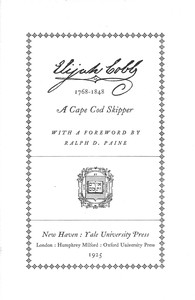
Elijah Cobb's memoir, written in a distinctive hand with erratic spelling and punctuation, opens a window into the life of a Cape Cod skipper navigating the treacherous waters of the early nineteenth century. The text, preserved in fragmentary letters and a narrative, is introduced by Ralph Delahaye Paine, who notes its 'fragmentary' nature. Cobb's prose is direct and unadorned, yet it carries the weight of lived experience, from the precise details of cargo and wind to the quiet joy of meeting a newborn daughter by moonlight.
A Voice Shaped by the Sea
Cobb's language is that of a man more accustomed to giving orders at sea than to writing for posterity. His spelling is phonetic and inconsistent—'freindly,' 'perticularly,' 'compleated'—and his punctuation is haphazard, with sentences sometimes ending without a period or beginning with a lowercase letter. This is not the polished prose of a literary figure but the raw record of a working captain. The transcriber's note warns of 'non-standard' spelling and random quotation marks, which the reader must navigate as one would a shifting wind. Yet within this rough texture lies a precise vocabulary of seamanship: 'hawl'd,' 'tack,' 'Gut of Gibraltar.' Cobb's voice is that of a man who knows his craft intimately, and his narrative gains authenticity from its very lack of refinement.
Pace and the Interruption of Domestic Life
The memoir's pace is uneven, mirroring the rhythms of a sailor's life. Long passages of careful navigation—calculating winds, avoiding blockades, negotiating with merchants—are suddenly broken by brief, poignant domestic scenes. After describing a successful voyage to Lübeck, Cobb writes of returning to Boston and visiting 'my dear family, at the cape; where I found an aditional pledge of affection, in a little black-eye’d daughter.' He then hauls the infant from bed to look at her by moonlight, a moment of tenderness that stands in stark contrast to the preceding account of cargo and canals. This juxtaposition is not sentimentalized; it is reported with the same matter-of-fact tone as the business of selling duck cloth. The effect is to remind the reader that Cobb's world is one where family and commerce are inextricably linked, and where the sea's demands allow only fleeting respites.
The Weight of Historical Circumstance
Cobb's narrative is steeped in the geopolitical tensions of his era. He recounts how the British Orders in Council, which forbade American vessels from taking return cargo from European ports, directly shaped his decisions. Arriving at Málaga in January 1808, he learns the orders went into effect the day before. The American consul advises him to risk a return cargo of wine and fruit, and Cobb agrees, calculating that prices will rise in America. His subsequent escape from an English frigate near Gibraltar is described with a sailor's eye for wind and tide: he waits for an easterly wind, plans to pass the Rock at dark, but is becalmed and boarded. The midshipman who takes charge suspects him of heading to Algeciras. Cobb's account is not a political treatise but a practical man's navigation of imperial power, where a change in wind or a consul's word could mean the difference between profit and capture.
Readers approaching Cobb's memoir should be prepared for a text that demands patience. The nonstandard spelling and erratic punctuation are not obstacles but features of a voice that speaks directly from the early republic. The narrative is best read aloud, allowing the rhythms of Cobb's speech to carry the story. Pay attention to the moments when the captain's professional detachment gives way to personal reflection—these are the hinges on which the memoir turns. And remember that what survives is fragmentary; the gaps are as telling as the words.
I keep thinking about Cobb’s logbook—how his quiet grief surfaces between compass readings, almost by accident. There’s something similar in Memoirs of the Life of Sir Walter Scott, Volume 5 (of 10) — A Reader’s Guide, where a busy public life holds private weariness underneath. Both men wrote through their days, and the feeling stays with you long after you close the page.
There are no reviews for this eBook.
There are no comments for this eBook.
Reader reflection
What did you think of this book?
Answer a few questions and save a private reflection on this device.
Your progress
0
/
10
2
How did the book work for you overall?
3
Would you encourage someone else to read it?
4
How demanding did the text feel?
5
How useful did the reading feel?
6
Did you relate to its people, ideas, or situations?
7
Do you expect to return to this book?
8
Did the book deliver what you hoped for?
9
What did this book teach you most?
10