1

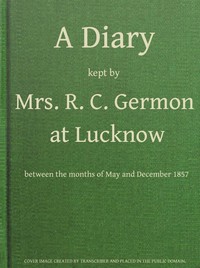
A Diary Kept by Mrs. R. C. Germon, at Lucknow, Between the Months of May and December, 1857 — A Closer Reading
(0 User reviews)
1121
Project Gutenberg
2014
Not confirmed
India -- History -- Sepoy Rebellion, 1857-1858; Lucknow (India) -- History -- Siege, 1857 -- Personal narratives; Germon, Maria
Readers of public-domain and historical texts
Project Gutenberg digital edition
en
Edition facts
Words
40,226
Reading time
175 min
Text sections
10
A Diary Kept by Mrs. R. C. Germon, at Lucknow, Between the Months of May and December, 1857 — A Closer Reading can be approached with a clearer sense of reading commitment from its source measurements: 40,226 words, 2 hr 55 min estimated reading time, and 10 detected text sections.
The text analysis averages about 18.1 words per sentence, while the detected sections provide another way to judge how the source is divided.
Project Gutenberg metadata also associates the work with “India -- History -- Sepoy Rebellion, 1857-1858,” connecting these edition facts with the source record’s subject description.
Source:
Project Gutenberg record #47814
Maria Germon's diary records daily life during the Siege of Lucknow in 1857, blending mundane details like meals and boils with sudden violence, as seen in entries about a European shot in the garden and a sortie spiking guns.
Editorial Edition Score
4.8/5
★★★★★
★★★★★
Calculated from edition completeness, EPUB availability, text structure and catalogue metadata. Not a user rating.
How this score is calculated
- Description quality20 pts
- Title & short description10 pts
- Source metadata20 pts
- Text length15 pts
- Chapters / structure15 pts
- EPUB file integrity20 pts
Total of 100 points, scaled to a 2.5-5.0 range. Editions with an empty description or a missing EPUB file are not scored.
Edition quality
Public-domain source text
Read the source text
The source text is kept in the dedicated reader, separate from this catalogue record and its commentary.
Maria Germon's diary, written day by day between May and December 1857, offers a record of the Siege of Lucknow that is at once intimate and unadorned. The preface states the text is in its 'original wording' with 'no attempts at embellishment,' a claim borne out by entries that juxtapose a husband's narrow escape from a round shot with the luxury of a roly-pudding made from ottah and suet. The catalog subjects classify this as a personal narrative of the Sepoy Rebellion, but the excerpts reveal a document that is less a chronicle of military events than a domestic survival log, where the rhythms of laundry, church, and dinner persist under bombardment.
Domesticity Under Siege
The diary's texture comes from its fusion of siege violence with domestic routine. On August 20, Germon records making an 'ottah poultice' for a boil on her hand while a European is shot in the garden. The next day's entry describes a night alarm that sends her and another woman scrambling over sleeping companions, provoking laughter rather than terror. Meals are meticulously noted: stewed beef, dal, rice, chupattees; roast mutton supplemented by tinned salmon; a pudding of ottah and suet called 'a perfect luxury.' These details ground the siege in the body's needs—hunger, pain, cleanliness—rather than in strategic overview. Germon's effort to have 'clean garments' on Sunday as 'one way of recognizing the day' shows how small rituals became anchors of normalcy.
The Diary's Self-Imposed Limits
The preface reveals deliberate omissions: 'The names of those who were actors in the fearful scenes have been omitted, from a feeling of delicacy towards some who are still alive.' This editorial choice shapes what the diary can tell us. In the excerpts, initials and dashes stand in for individuals—Mr. C——, Mrs. A——, J——s' house—creating a partial anonymity that frustrates identification but also signals the author's awareness of a private audience. The diary was printed in 1870 for 'private circulation,' as a sister's prefatory letter explains, and Germon's husband, who commanded an outpost, vetted events outside her observation. Readers must therefore weigh what is recorded against what is withheld, and recognize that the diary is both a personal record and a curated document.
The Texture of Waiting and Violence
Recurring phrases like 'No news again!' and 'very little firing to-day' mark the siege as a period of tense waiting punctuated by sudden, intimate violence. On August 24, a round shot enters the house; on August 25, an attack on the Bailey Guard Gate keeps the household awake. Yet the same entry notes that a couple arrived 'both so nicely dressed; one could hardly fancy the siege was going on.' This oscillation between the quotidian and the catastrophic is the diary's structural principle. Germon does not reflect on the larger rebellion; she records what she sees and hears from her corner of the entrenchment. The result is a document that conveys the siege's duration through accumulation—of sleepless nights, scarce cups, and the longing for flowers—rather than through dramatic narrative.
Readers approaching this diary should attend to what it includes and what it omits. The catalog subjects frame it as a historical source on the Sepoy Rebellion, but the text itself resists that framing, offering instead a record of constrained domestic life under fire. The diary's value lies in its specificity—the silver mug used for tea, the bouquet of roses and tuberoses—and in its refusal to become a heroic account. It is a document best read slowly, entry by entry, for the way it makes the siege tangible through its smallest details.
That rainy afternoon, Maria Germon’s boiled potatoes and sudden gunfire blurred into one anxious rhythm, and I kept thinking how faith must stutter through such days. Hours later, I found myself flipping through "Billy" Sunday, the Man and His Message With his own words which have won thousands for Christ — Inside the Classic, and his roaring certainty felt almost like a reply to her meticulous quiet. Strange, how one book simply opens another.
There are no reviews for this eBook.
There are no comments for this eBook.
Reader reflection
Take a moment to reflect on this book
Create a short personal record of your experience with this book.
Your progress
0
/
10
2
How much did you enjoy the reading experience?
3
How likely are you to recommend this book?
4
How demanding did the text feel?
5
Which part made the strongest impression?
6
Do you expect to return to this book?
7
Would you start a conversation about this book?
8
How much did the book move you?
9
What did this book teach you most?
10