1

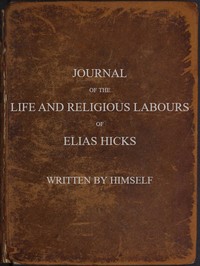
Journal of the Life and Religious Labours of Elias Hicks — Background and Themes
(0 User reviews)
1114
Project Gutenberg
2020
Not confirmed
Hicks, Elias, 1748-1830 -- Diaries; Quakers -- United States -- Diaries; Hicksites
Readers of public-domain and historical texts
Project Gutenberg digital edition
en
Edition facts
Words
172,414
Reading time
750 min
Text sections
25
The source record for Journal of the Life and Religious Labours of Elias Hicks — Background and Themes measures this digital text at 172,414 words, 12 hr 30 min estimated reading time, and 25 detected text sections.
The text analysis averages about 32.4 words per sentence, while the detected sections provide another way to judge how the source is divided.
Project Gutenberg metadata also associates the work with “Hicks, Elias, 1748-1830 -- Diaries,” connecting these edition facts with the source record’s subject description.
Source:
Project Gutenberg record #61777
Elias Hicks's journal records his travels and religious labors as a Quaker minister, structured by dated entries that move between meetings, family life, and inner spiritual struggles, with recurring imagery of refining fire and the inward coming of God.
Editorial Edition Score
4.9/5
★★★★★
★★★★★
Calculated from edition completeness, EPUB availability, text structure and catalogue metadata. Not a user rating.
How this score is calculated
- Description quality20 pts
- Title & short description10 pts
- Source metadata20 pts
- Text length15 pts
- Chapters / structure15 pts
- EPUB file integrity20 pts
Total of 100 points, scaled to a 2.5-5.0 range. Editions with an empty description or a missing EPUB file are not scored.
Edition quality
Public-domain source text
Read the source text
The source text is kept in the dedicated reader, separate from this catalogue record and its commentary.
Elias Hicks's journal opens not with a narrative of his birth but with a preface by his connections, who assembled the manuscript after his death. The work itself is a record of religious engagements, structured by dated entries that trace his movements across Quaker meetings in New York, New England, Pennsylvania, and beyond. Hicks writes in a plain, earnest voice, often noting his bodily indisposition alongside spiritual consolation. The journal's rhythm alternates between public ministry—where he preaches on the inward coming of God as a refiner with fire—and private reflection, where he measures his peace of mind against physical pain. This dual focus on outer travel and inner condition gives the text a distinctive texture, as each entry becomes a small drama of waiting, labor, and occasional release.
The Movement of the Journal: Travel as Spiritual Discipline
The journal is organized by journeys, each chapter heading listing a sequence of visits: “Visit to Nine Partners, 1783. Visit on Long Island, 1784. Visit to New-York and Staten Island, 1790.” This catalog of destinations is not merely itinerary; it reflects a life given over to the discipline of travel. Hicks rarely stays long in one place. He moves from meeting to meeting, often under physical strain, and the act of traveling itself becomes a test of faith. In one entry, he writes of almost giving up the prospect of getting to meeting, but “put on my usual resolution and went,” finding peace there. The journal thus traces a geography of spiritual labor, where each new location offers an opportunity for ministry and for the inward arising of God.
Recurring Images: Refining Fire and the Inward Physician
Hicks returns repeatedly to a cluster of biblical images: the refiner with fire, the fuller with soap, the balm in Gilead, the physician. These are not decorative; they structure his theology. He insists that salvation comes not from outward observance but from an inward purification: “it is also necessary for us to know this arising to be within us and not without us.” The strong man armed must be bound and cast out by a stronger—God—who cleanses the heart. This language of refining and cleansing appears in multiple entries, often in the same phrasing, suggesting a core set of convictions that Hicks adapts to each audience. The repetition gives the journal a homiletic unity, even as the settings change.
The Body in the Text: Pain, Peace, and the Daily Round
Hicks is remarkably candid about his physical state. He records “much bodily pain, which is more or less my common lot,” and notes that severe pain can be endured “without a murmuring thought” when accompanied by peace of mind. This attention to the body is not incidental; it anchors his spiritual claims in concrete experience. The journal moves between public meetings and private days spent “in my family affairs, mostly attended with sweet peace of mind.” The domestic and the ministerial are interwoven. Hicks does not present himself as a disembodied voice; he is a man who feels pain, who attends funerals of careless neighbors, who hopes his labor will be “as bread cast upon the waters.”
Structure and Silence: What the Journal Leaves Unsaid
The journal’s structure is deceptively simple: dated entries, each recording a meeting, a journey, or a day at home. But within this framework, much is left implicit. Hicks rarely explains his motives for a particular journey; he simply records that he undertook it. The preface notes that the manuscript was collected after his death, and the journal itself offers no overarching narrative arc. Readers must infer connections between entries. The silence around certain events—the war, for instance, is mentioned only in a chapter heading—suggests that Hicks’s focus is relentlessly inward. The journal is not a chronicle of outward history but a record of the soul’s progress, and its gaps are as telling as its entries.
Readers approaching this journal should attend to its rhythms: the alternation of travel and rest, of public preaching and private pain. Hicks’s voice is consistent but not monotonous; his repetitions reveal what mattered most to him. The journal rewards slow reading, allowing the reader to trace the movement of a mind that sought, above all, to know the inward arising of God. It is a document of spiritual discipline, not a narrative of events, and its value lies in the patient attention it demands.
There’s something about reading Elias Hicks’s restless entries—his fire and waiting—that makes me think of those old court ladies, their quiet days measured in ink and longing. Both felt time passing through them, and left us only the warmth of their noticing. I keep Journal near Diaries of Court Ladies of Old Japan — A Closer Reading now, two kinds of patience side by side.
There are no reviews for this eBook.
There are no comments for this eBook.
Reader reflection
How did this book work for you?
Your answers remain private and are stored only in this browser.
Your progress
0
/
10
2
Was reading this book enjoyable?
3
How likely are you to recommend this book?
4
What was the reading difficulty like?
5
Would you start a conversation about this book?
6
How would you describe its reading pace?
7
Did the book meet your expectations?
8
Did the book offer a fresh perspective?
9
What is the main idea you are taking away?
10