1

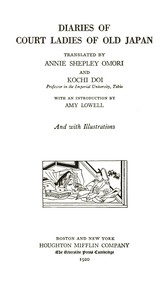
Diaries of Court Ladies of Old Japan — A Closer Reading
(0 User reviews)
344
Project Gutenberg
2014
Not confirmed
Japanese diaries -- Women authors -- Translations into English; Japan -- Court and courtiers
Readers of public-domain and historical texts
Project Gutenberg digital edition
en
Edition facts
Words
60,865
Reading time
265 min
Text sections
8
For Diaries of Court Ladies of Old Japan — A Closer Reading, the stored edition analysis reports 60,865 words, 4 hr 25 min estimated reading time, and 8 detected text sections.
The text analysis averages about 17.0 words per sentence, while the detected sections provide another way to judge how the source is divided.
Project Gutenberg metadata also associates the work with “Japanese diaries -- Women authors -- Translations into English,” connecting these edition facts with the source record’s subject description.
Source:
Project Gutenberg record #47151
Three Heian-era court women—Murasaki Shikibu, Izumi Shikibu, and Sugawara no Takasue no Musume—record daily life, poetry exchanges, and religious yearning. The translators' note reveals challenges in rendering evanescent, half-expressed sentences and poems into English, using third person to preserve shy reserve.
Editorial Edition Score
4.7/5
★★★★★
★★★★★
Calculated from edition completeness, EPUB availability, text structure and catalogue metadata. Not a user rating.
How this score is calculated
- Description quality20 pts
- Title & short description10 pts
- Source metadata20 pts
- Text length15 pts
- Chapters / structure15 pts
- EPUB file integrity20 pts
Total of 100 points, scaled to a 2.5-5.0 range. Editions with an empty description or a missing EPUB file are not scored.
Edition quality
Public-domain source text
Read the source text
The source text is kept in the dedicated reader, separate from this catalogue record and its commentary.
The three diaries in this volume share a distinctive tension between the outward spectacle of Heian court life and an inner current of melancholy and religious longing. In the excerpt from Murasaki Shikibu's diary, the narrator watches waterfowl playing in a pond and immediately reflects: 'It is not gay to live anxiously seeking means of existence.' This pattern—observing a scene, then turning it into a poem that questions its surface gaiety—recurs throughout the texts. The translators, Annie Shepley Omori and Kochi Doi, note in their preface that Izumi Shikibu's diary is 'written with extreme delicacy of treatment,' and that they have used the third person to suggest the 'shy reserve' of the original. Readers should attend to the interplay between precise visual details (a chrysanthemum-coloured robe, a blue-green hairband) and the diarists' habit of undercutting those details with doubt.
Poetry as Social Currency and Private Release
The diaries are punctuated by poems exchanged between ladies and courtiers, often written on perfumed, deeply coloured paper. These verses serve both as social obligations and as outlets for genuine feeling. In one exchange, Lady Koshosho sends a poem about 'the down-dripping rain' and longing, and the diarist replies with a poem contrasting the pauses between showers with her own continuously wet sleeves. The translators warn that the poems depend on 'plays upon words of two meanings' and cultural associations that are difficult to convey in English. Even so, the reader can observe how the poems crystallize a moment of emotion—often sorrow or yearning—and how they are embedded in the flow of daily events, such as dressing hair or waiting for the Emperor's delayed arrival.
The Weight of Ceremony and the Glimpse of Unease
The description of the King's visit reveals a court obsessed with rank and display. The diarist notes the precise placement of chairs, the colours of robes, and the shape of hair tied with bands. Yet she also records small, telling details of discomfort: a lady who 'seemed a little shy and I was sorry for her,' and bearers who bent their heads 'in absolute humility' that struck the observer as 'too humble.' These observations suggest that the diarist is not merely recording protocol but is attuned to the human cost of such formality. The tension between the ideal of courtly grace and the reality of awkwardness or excess humility is a recurring undercurrent.
Religious Yearning Amidst Worldly Beauty
Throughout the excerpts, the diarist expresses a desire to withdraw from the world and embrace a religious life. She writes: 'I wish I could be more adaptable and live more gaily in the present world—had I not an extraordinary sorrow—but whenever I hear delightful or interesting things my yearning for a religious life grows stronger.' This conflict is not resolved; it is simply stated and then followed by a poem or a description of a beautiful object, such as chrysanthemums seen through morning mists. The juxtaposition of aesthetic pleasure and spiritual longing is a defining feature of these diaries. The reader should note how often the diarist uses natural imagery—waterfowl, rain, flowers—as a springboard for introspection about impermanence and sin.
These diaries reward a patient reading that pays attention to what is left unsaid as much as to what is recorded. The translators' decision to use the third person for Izumi Shikibu's diary is a clue: the narrators often seem to be observing themselves from a distance, as if their own lives were as puzzling as the court rituals they describe. Look for the moments when a concrete detail—a robe's colour, a boat's dragon head—suddenly opens onto a question about the meaning of existence. That is where the diaries are most alive.
I keep returning to those Heian ladies’ half-said sentences, their shy reserve barely holding against the ache beneath—and it reminds me of how Richard’s chronicles feel similarly guarded, a man hiding his own longing behind action. Richard the Lion Heart — Reading Notes carries that same quiet hush, as though some things are best left unspoken, merely kept near. We are lucky to eavesdrop.
There are no reviews for this eBook.
There are no comments for this eBook.
Reader reflection
Take a moment to reflect on this book
Create a short personal record of your experience with this book.
Your progress
0
/
10
2
How much did you enjoy the reading experience?
3
Is this a title you would suggest to others?
4
Did the language feel accessible?
5
How did the pace of the book feel?
6
Would a second reading be valuable?
7
How well did it match your expectations?
8
Did it raise ideas you would like to talk about?
9
What is the main idea you are taking away?
10