1

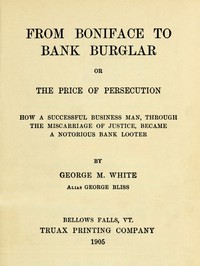
From Boniface to Bank Burglar; Or, The Price of Persecution How a Successful Business Man, Through the Miscarriage of Justice, Became a Notorious Bank Looter — A Reader’s Guide
(0 User reviews)
720
Project Gutenberg
2018
Not confirmed
Criminals -- Biography; White, George M. (George Miles); Bank robberies -- United States
Readers of public-domain and historical texts
Project Gutenberg digital edition
en
Edition facts
Words
126,106
Reading time
549 min
Text sections
36
Before opening From Boniface to Bank Burglar; Or, The Price of Persecution How a Successful Business Man, Through the Miscarriage of Justice, Became a Notorious Bank Looter — A Reader’s Guide, the edition data offers a quick orientation: 126,106 words, 9 hr 9 min estimated reading time, and 36 detected text sections.
The text analysis averages about 21.2 words per sentence, while the detected sections provide another way to judge how the source is divided.
Project Gutenberg metadata also associates the work with “Criminals -- Biography,” connecting these edition facts with the source record’s subject description.
Source:
Project Gutenberg record #57760
George M. White's 1905 memoir recounts his transformation from a successful hotelier to a bank burglar, driven by a miscarriage of justice. Written from a prison cell, the narrative blends precise criminal logistics with personal reflection, offering a firsthand account of late-19th-century bank robberies and the author's evolving moral justifications.
Editorial Edition Score
4.9/5
★★★★★
★★★★★
Calculated from edition completeness, EPUB availability, text structure and catalogue metadata. Not a user rating.
How this score is calculated
- Description quality20 pts
- Title & short description10 pts
- Source metadata20 pts
- Text length15 pts
- Chapters / structure15 pts
- EPUB file integrity20 pts
Total of 100 points, scaled to a 2.5-5.0 range. Editions with an empty description or a missing EPUB file are not scored.
Edition quality
Public-domain source text
Read the source text
The source text is kept in the dedicated reader, separate from this catalogue record and its commentary.
White opens his 1905 memoir with a preface written from a prison cell, framing the book as both a warning and a practical guide for those handling large sums of money. He claims to have compiled his life story from memory alone, without written records, and acknowledges that errors may creep in. This origin—composed during solitary hours while others slept—shapes the entire work: the narrative is retrospective, self-justifying, and unapologetically detailed about criminal methods.
The table of contents reveals a two-part structure, moving from hotel days and a first burglary to later exploits like the Cadiz bank loot and a scheme against the Brevoort Stables. White’s voice is direct and businesslike, even when describing perilous escapes, as when he rigs a cable of clothes-lines and horse reins to cross a skeleton bridge during a storm.
A Prison-Born Project
The preface establishes White’s dual purpose: to help financiers guard against crime and to warn those tempted by wrongdoing. He writes that he “resolved that no more of life’s precious years should be spent in sowing to the wind,” yet the book’s title and content celebrate his notoriety as a bank looter. This tension between reform and pride runs throughout. White admits he kept no records because “in leading the life of a transgressor it is not conducive to safety,” so he relied on memory—a claim that invites skepticism but also gives the narrative a confessional, episodic quality. The preface’s closing note, that “facts crowded upon me until I have been enabled to issue a volume of no mean proportions,” suggests White saw his story as both cautionary and commercially appealing.
The Bridge Crossing: A Set Piece of Nerve
One excerpt describes a nighttime escape across an unfinished bridge during a storm. White and his accomplice Mark use two clothes-lines and three pairs of horse reins to create a cable. White ties it around his body and crawls on planks above a roaring river, with the wind making “wild, weird music” through the wires. He arranges a signal system—three pulls on the cable to indicate safe crossing—and tells Mark to cut the rope if he falls, preferring death to dangling and freezing. The scene is vivid and technical, showing White’s ability to improvise under pressure. It also reveals his theatrical side: he calls back a goodbye before starting, and later laughs at Mark’s profanity. This blend of danger and dark humor recurs in the excerpts.
Memory as the Only Record
White repeatedly emphasizes that he wrote from memory, without diaries or notes. In the preface he says, “I kept no record of events, for in leading the life of a transgressor it is not conducive to safety; so I have been forced to depend solely upon my memory.” This disclaimer serves several functions: it excuses possible inaccuracies, it heightens the drama of recollection, and it positions White as a man who lived so dangerously that he could not afford paper trails. The result is a narrative that feels immediate but also unreliable. Readers must weigh White’s self-serving claims against the detailed logistics he provides—details that suggest either a remarkable memory or a degree of fabrication.
The Businessman’s Voice
Despite his criminal career, White writes in the tone of a businessman addressing other businessmen. The subtitle promises the story of “a successful business man” turned bank looter, and the preface targets “the financial world and general public.” His descriptions of burglaries often read like commercial transactions: he calculates risks, manages accomplices, and assesses loot. In the bridge episode, he refers to a “treasure satchel” and plans the cable’s length with practical precision. This professional veneer makes the memoir unusual among criminal autobiographies. White does not glamorize violence or portray himself as an outlaw hero; instead, he presents crime as a risky enterprise that failed, and his book as a post-mortem analysis for those who might learn from his mistakes.
White’s memoir rewards readers who attend to its practical details and its narrator’s shifting self-presentation. The bridge crossing, the preface’s prison origin, and the businesslike tone all point to a man who saw himself as both a cautionary example and a skilled operator. Because the excerpts cover only portions of the book, the full arc of White’s moral reasoning—from persecution to bank looting—remains to be explored. First-time readers should watch for how White justifies each crime and where his claims of reform ring hollow or sincere.
That rainy afternoon, White’s careful notes on dynamite and ledgers felt less like crime and more like accounting—a man itemizing his own ruins. Near the end, his quiet longing for solitude reminded me of something calmer, so I reached for Henry D. Thoreau — Reading Notes, and the rain seemed to slow, matching his pace.
There are no reviews for this eBook.
There are no comments for this eBook.
Reader reflection
What did you think of this book?
Answer a few questions and save a private reflection on this device.
Your progress
0
/
10
2
What was your overall reaction to the book?
3
How likely are you to recommend this book?
4
How easy was the book to follow?
5
How did the reading compare with what you expected?
6
How strongly did the book affect you emotionally?
7
Would you like to discuss this book with someone?
8
How would you rate its originality?
9
Which lesson or insight stayed with you?
10