1

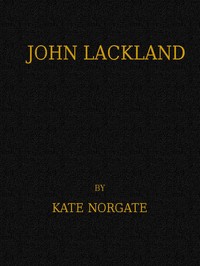
John Lackland — Key Ideas to Explore
(0 User reviews)
457
Project Gutenberg
2018
Not confirmed
Great Britain -- Kings and rulers -- Biography; Great Britain -- History -- John, 1199-1216; John, King of England, 1167-1216
Readers of public-domain and historical texts
Project Gutenberg digital edition
en
Edition facts
Words
122,895
Reading time
535 min
Text sections
28
The source record for John Lackland — Key Ideas to Explore measures this digital text at 122,895 words, 8 hr 55 min estimated reading time, and 28 detected text sections.
The text analysis averages about 26.2 words per sentence, while the detected sections provide another way to judge how the source is divided.
Project Gutenberg metadata also associates the work with “Great Britain -- Kings and rulers -- Biography,” connecting these edition facts with the source record’s subject description.
Source:
Project Gutenberg record #58310
Kate Norgate's 1902 biography examines John's reign through a close reading of chronicles, charters, and correspondence, arguing that his failures stemmed not from indolence but from ruthless competence. The text balances military campaigns in Ireland, Wales, and France with administrative and ecclesiastical conflicts, revealing a king whose strategic decisions—such as surrendering England to the papacy—were calculated gambles.
Editorial Edition Score
4.9/5
★★★★★
★★★★★
Calculated from edition completeness, EPUB availability, text structure and catalogue metadata. Not a user rating.
How this score is calculated
- Description quality20 pts
- Title & short description10 pts
- Source metadata20 pts
- Text length15 pts
- Chapters / structure15 pts
- EPUB file integrity20 pts
Total of 100 points, scaled to a 2.5-5.0 range. Editions with an empty description or a missing EPUB file are not scored.
Edition quality
Public-domain source text
Read the source text
The source text is kept in the dedicated reader, separate from this catalogue record and its commentary.
Kate Norgate opens her study of John with an epigraph from John Richard Green that sets the interpretive stakes: John was 'the ablest and most ruthless of the Angevins,' not the weak voluptuary of popular memory. The biography, first published in 1902, draws extensively on chronicles, charters, and pipe rolls to reconstruct a reign marked by military campaigns in Ireland, Wales, and France, as well as by the protracted conflict with the papacy that culminated in England becoming a papal fief. Norgate's method is to let the documentary record—often in the original Latin or French—speak for itself, while she supplies connective analysis. The result is a work that foregrounds the tension between John's administrative energy and his political isolation.
The Evidence of the Chronicles
Norgate weaves together multiple chronicle traditions, often juxtaposing English, Welsh, and continental sources. In the account of John's 1211 Welsh campaign, she quotes a Welsh chronicler who reports that the king's army suffered such scarcity that 'an egg was sold for a penny halfpenny' and men ate horseflesh. The same chronicler notes that John later returned with a larger force, burned Bangor, and seized the bishop of Bangor, ransoming him for 'two hundred hawks.' Norgate does not resolve the discrepancy between the first campaign's 'disgrace' and the second's success; instead, she lets the sources stand in tension, inviting readers to weigh the biases of each witness. The frequent citation of Rotuli Chartarum, Rotuli Patentium, and the Histoire de Guillaume le Maréchal grounds the narrative in administrative and poetic records alike.
John's Irish Policy and Its Limits
The maps included in the volume—Ireland according to the Treaty of 1175, Henry II's distribution of 1177, and Ireland in 1185 and 1210—signal the importance of Irish affairs to Norgate's argument. She traces John's two expeditions to Ireland (1185 and 1210) and his efforts to impose royal authority on Anglo-Norman lords such as the de Braoses and the Lacys. The footnotes reveal a dense web of charter evidence: an inquisition of April 1206 implies that the eastern half of the 'kingdom of Cork' was in the king's hands, while the itinerary shows John moving from Dublin to Fishguard in two days in August 1210. Norgate's attention to such details underscores the logistical and legal complexity of medieval kingship, even as the narrative makes clear that John's Irish settlements proved fragile.
The Papal Settlement as Political Calculation
Chapter V opens with a Latin quotation from Walter of Coventry that describes John's surrender of England to the papacy as a prudent act: 'there was no shorter way to escape the imminent danger, nor perhaps any other.' Norgate does not endorse this judgment, but she presents it as a contemporary perspective that complicates later condemnations. The chapter details the negotiations with Pandulf, the collection of Peter's Pence, and the baronial resentment that followed. By juxtaposing the chronicler's language of 'ignominy' and 'yoke of servitude' with the king's own pragmatic reasoning, Norgate highlights the gap between modern moral assessments and medieval political realities. The text refrains from declaring whether John's submission was cynical or desperate, leaving readers to decide from the evidence assembled.
Readers approaching John Lackland should attend to the footnotes and appendices, where Norgate conducts much of her argumentative work. The notes on John and the de Braoses and on Eustace de Vesci and Robert Fitz-Walter offer case studies in the king's methods of coercion and the baronial responses they provoked. The index, too, rewards consultation: entries for 'hostages,' 'castles,' and 'fines' reveal recurring patterns in John's governance. Norgate's biography is less a narrative than an archive in miniature, inviting the reader to become a collaborator in the work of historical judgment.
Reading Norgate’s John, I kept thinking how competence without grace can feel like its own kind of siege. It reminded me of winter evenings spent with A Diary Kept by Mrs. R. C. Germon, at Lucknow, Between the Months of May and December, 1857, where the ordinary—a meal, a quiet hour—becomes the most radical resistance. A Diary Kept by Mrs. R. C. Germon, at Lucknow, Between the Months of May and December, 1857 — A Closer Reading holds that same strange stillness amid upheaval, a record of surviving, not conquering.
There are no reviews for this eBook.
There are no comments for this eBook.
Reader reflection
How did this book work for you?
Your answers remain private and are stored only in this browser.
Your progress
0
/
10
2
How much did you enjoy the reading experience?
3
How likely are you to recommend this book?
4
How demanding did the text feel?
5
How understandable was the text?
6
Which aspect of the book did you value most?
7
What did you think about the pace?
8
How useful did the reading feel?
9
Which lesson or insight stayed with you?
10