1

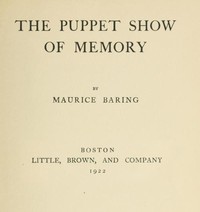
The Puppet Show of Memory — Key Ideas to Explore
(0 User reviews)
281
Project Gutenberg
2018
Not confirmed
Authors, English -- 20th century -- Biography; Baring, Maurice, 1874-1945; Travel writers -- Great Britain -- Biography; War correspondents -- Great Britain -- Biography
Readers of public-domain and historical texts
Project Gutenberg digital edition
en
Edition facts
Words
190,469
Reading time
829 min
Text sections
20
This digital edition of The Puppet Show of Memory — Key Ideas to Explore is described by source-level measurements including 190,469 words, 13 hr 49 min estimated reading time, and 20 detected text sections.
The text analysis averages about 18.9 words per sentence, while the detected sections provide another way to judge how the source is divided.
Project Gutenberg metadata also associates the work with “Authors, English -- 20th century -- Biography,” connecting these edition facts with the source record’s subject description.
Source:
Project Gutenberg record #57158
Maurice Baring's memoir opens with a reflection on memory's artistry, then moves through childhood, Eton, and European travels, culminating in detailed theatre criticism and Russian observations. The excerpts show a writer who values precise recollection and comparative analysis.
Editorial Edition Score
4.9/5
★★★★★
★★★★★
Calculated from edition completeness, EPUB availability, text structure and catalogue metadata. Not a user rating.
How this score is calculated
- Description quality20 pts
- Title & short description10 pts
- Source metadata20 pts
- Text length15 pts
- Chapters / structure15 pts
- EPUB file integrity20 pts
Total of 100 points, scaled to a 2.5-5.0 range. Editions with an empty description or a missing EPUB file are not scored.
Edition quality
Public-domain source text
Read the source text
The source text is kept in the dedicated reader, separate from this catalogue record and its commentary.
Maurice Baring begins The Puppet Show of Memory by questioning the value of diaries, arguing that memory itself is "the greatest of artists" because it eliminates the unessential. His earliest recollection—a Christmas tree in 1876 and a beloved yellow-and-red bird—sets a pattern of vivid, sensory detail. The memoir then proceeds chronologically through nursery, school, and European travels, but the excerpts reveal that Baring is less concerned with continuous narrative than with preserving scenes that have survived mental editing.
Memory as Selective Artist
Baring explicitly frames his project as a work of selection, not accumulation. He recalls an Eton master who advised keeping a daily diary to make a fortune, but notes that no boy took the advice. Instead, Baring celebrates the compensatory power of forgetting: memory chooses "with careless skill the sights and the sounds and the episodes that are best worth remembering." This principle governs the entire memoir. The earliest memory—a Christmas present of a bird with "yellow and red plumage"—is offered not as a factual anchor but as an example of how a single object can irradiate a whole period. Readers should watch for similar talismanic details: a toy, a gesture, a phrase that seems to stand for more than itself.
Theatre Criticism as Comparative Art
One of the longest excerpted passages is a sustained comparison of Sarah Bernhardt and Eleonora Duse in the role of Magda. Baring does not simply praise; he dissects. He argues that Duse lent the character "a nobility and a dignity that are not to be found in the text," while Bernhardt made Magda what the author intended: "a rather noisy, exuberant, vulgar, successful prima donna." He then extends the comparison to other roles—Césarine, Cleopatra, Phèdre—insisting that each actress had strengths the other lacked. The passage is notable for its refusal to declare a winner: "I am thankful to have seen them both, and to have thought each unapproachable in her own way." This balanced, analytical voice recurs throughout the excerpts and suggests that Baring values discrimination over partisanship.
The Russian Sections and the Observer's Stance
Baring's chapters on Russia (XVI–XIX, XXIV) draw on material previously published in A Year in Russia and Russian Essays. The excerpts do not include those chapters, but the table of contents shows he covered the beginning of the Revolution, travel in South Russia, and Constantinople. The catalog lists him as a war correspondent and travel writer, and the memoir's structure—moving from nursery to Eton to Germany, Italy, Paris, and then to Russia and Manchuria—suggests a life shaped by mobility. Readers approaching the Russian sections should expect the same observational precision visible in the theatre criticism: Baring is likely to describe scenes and people with an eye for telling detail rather than broad political analysis. The memoir's title, The Puppet Show of Memory, hints that even historical events may be presented as remembered performances.
Structural Clues from the Table of Contents
The book contains twenty-four chapters plus an index, moving from "The Nursery" (Chapter I) to "The Fascination of Russia" (Chapter XXIV). The middle chapters cluster around theatre (XII on Sarah Bernhardt), war correspondence (XIV–XV on Russia and Manchuria, XXII on the Balkan War), and travel (XIX, XXI, XXIII). Baring acknowledges debts to Messrs. Methuen for permission to reuse earlier published material, and to Father C. C. Martindale and Desmond MacCarthy for proofreading. The front matter includes a note that printer's mistakes in the index have been corrected to match the main text. These paratextual details confirm that the memoir is a curated compilation, not a spontaneous outpouring. Readers should treat each chapter as a self-contained essay that may have originated in a different context.
Because the excerpts are drawn from the opening and a middle chapter, the full arc of Baring's memoir remains partially hidden. What is clear is his method: he trusts memory's power to compress and clarify, and he applies a critic's eye to both art and life. Readers will benefit from noting how each chapter's opening scene or anecdote functions as a synecdoche for the whole. The book rewards those who read slowly, alert to the single image that Baring has chosen to stand for years.
There’s something about how Baring lets memory shape itself, almost like a quiet conversation with the past, that stayed with me long after. It reminded me of another voice, Elias Hicks, who also trusted inner reflection over outward noise. Both feel like sitting beside a friend who remembers slowly. Journal of the Life and Religious Labours of Elias Hicks — Background and Themes carries that same gentle, unhurried weight.
There are no reviews for this eBook.
There are no comments for this eBook.
Reader reflection
Your personal reading reflection
Build a private reading journal entry for this title.
Your progress
0
/
10
2
How did the book work for you overall?
3
Is this a title you would suggest to others?
4
How easy was the book to follow?
5
Did this book create an emotional response?
6
How clear did the writing feel?
7
Is this a title worth rereading?
8
How strong was your personal connection to the text?
9
Which lesson or insight stayed with you?
10