1

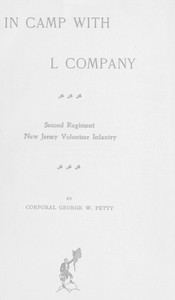
In Camp with L Company, Second Regiment New Jersey Volunteer Infantry — A Reader’s Guide
(0 User reviews)
2016
Project Gutenberg
2021
Not confirmed
Spanish-American War, 1898 -- Personal narratives; Spanish-American War, 1898 -- Regimental histories -- United States; United States. Army. New Jersey Infantry Regiment, 2nd (1898)
Readers of public-domain and historical texts
Project Gutenberg digital edition
en
Edition facts
Words
24,749
Reading time
108 min
Text sections
3
For In Camp with L Company, Second Regiment New Jersey Volunteer Infantry — A Reader’s Guide, the stored edition analysis reports 24,749 words, 1 hr 48 min estimated reading time, and 3 detected text sections.
The text analysis averages about 19.5 words per sentence, while the detected sections provide another way to judge how the source is divided.
Project Gutenberg metadata also associates the work with “Spanish-American War, 1898 -- Personal narratives,” connecting these edition facts with the source record’s subject description.
Source:
Project Gutenberg record #64406
Corporal George W. Petty's firsthand account of L Company, Second New Jersey Volunteer Infantry during the Spanish-American War, blending camp routines, rifle competitions, and a vivid tour of St. Augustine's historic sites.
Editorial Edition Score
4.6/5
★★★★★
★★★★★
Calculated from edition completeness, EPUB availability, text structure and catalogue metadata. Not a user rating.
How this score is calculated
- Description quality20 pts
- Title & short description10 pts
- Source metadata20 pts
- Text length15 pts
- Chapters / structure15 pts
- EPUB file integrity20 pts
Total of 100 points, scaled to a 2.5-5.0 range. Editions with an empty description or a missing EPUB file are not scored.
Edition quality
Public-domain source text
Read the source text
The source text is kept in the dedicated reader, separate from this catalogue record and its commentary.
Corporal George W. Petty opens his narrative not with a declaration of war but with the quiet mechanics of peacetime soldiering: Company L was mustered into state service on June 22, 1893, and the first pages read like a regimental scorecard. Petty records annual rifle standings—sixth, fourth, second—and notes a silver loving cup donated by Lieutenant Brunner for squad matches. The armory, built in 1896–97, cost about $20,000 and included a stage and living quarters. This meticulous cataloging of marksmanship percentages and drill schedules establishes a voice that values precision and pride in unit performance, long before any mention of mobilization.
From State Records to War Footing
The transition from state militia to federal service is marked by a shift in Petty's prose. Early chapters dwell on inspection scores and range conditions—"our discipline was excellent and our annual inspection invariably showed 100 per cent"—but as the muttering of war begins, the language quickens. Petty notes that during the winter of 1897–98, particular attention was given to drills in extended order, and when spring opened, the pace of the narrative accelerates. The author does not dwell on political causes; instead, he records the practical adjustments: new equipment, changed schedules, and the quiet tension of men waiting. The reader senses that the same eye that tracked sharpshooter counts now watches for signs of departure.
St. Augustine: A Soldier's Sightseeing
Once in Florida, Petty's narrative voice shifts again, adopting the tone of a curious tourist. He describes the Plaza where Menendez landed in 1565, the old Cathedral with chimes dated 1682, and the coquina walls of the fort. His observations are concrete: "fine bread, green corn, roast lamb and golden butter, and to crown all, a heaping saucer of ice cream, and all for 25 cents." He notes the slave market platform, the Dade massacre monuments, and Osceola's capture. The prose becomes a catalog of sights—banana trees, date palms, oleanders—but always with a soldier's eye for detail. The ordnance sergeant's gaze at the fort reminds the reader that this is still a military man on duty.
Pace and the Unfinished Journey
The excerpts available end abruptly, leaving the narrative suspended in St. Augustine. Petty's structure so far alternates between methodical record-keeping and descriptive travelogue. The rifle-match statistics and armory costs belong to a peacetime world; the later passages, with their Spanish moss and coquina forts, suggest a widening horizon. Yet the author never explains how the company reached Florida or what campaigns followed. This gap is significant: the reader must infer that the war itself—the "little world of warfare" promised in the opening epigraph—remains largely outside these pages. Petty's voice, precise in the armory and vivid in the plaza, leaves the actual combat unwritten.
Petty's account is best read as a fragment of a soldier's experience, focused on the before and the between rather than the battle. The reader should attend to the shifts in register—from statistical pride to tourist wonder—as clues to how the author understood his service. The missing war is a silence worth noticing.
I kept thinking about how the camp felt like home to those men, the small routines and rifle scores carrying real weight. Petty’s tour of St. Augustine stayed with me oddly long. It reminded me of another quiet voice, one who wrote down seventeen years of service the same unhurried way. The Military Sketch-Book, Vol. 2 (of 2) Reminiscences of seventeen years in the service abroad and at home — Text and Context holds that same gentle patience, like a friend sharing old photographs without hurry.
There are no reviews for this eBook.
There are no comments for this eBook.
Reader reflection
Your personal reading reflection
Build a private reading journal entry for this title.
Your progress
0
/
10
2
What was your overall reaction to the book?
3
Would you pass this book on to a friend?
4
Did the language feel accessible?
5
How personally connected did you feel to the book?
6
How strongly did the book affect you emotionally?
7
Could you see yourself revisiting this book?
8
How valuable was this book for your own interests?
9
What changed or sharpened your thinking?
10