1

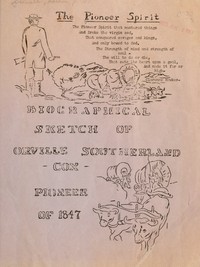
Orville Southerland Cox, Pioneer of 1847 — A Closer Reading
(0 User reviews)
393
Project Gutenberg
2015
Not confirmed
Cox, Orville Southerland, 1814-1888; Pioneers -- Utah -- Manti -- Biography; Latter Day Saint pioneers -- Utah -- Manti -- Biography; Manti (Utah) -- Biography
Readers of public-domain and historical texts
Project Gutenberg digital edition
en
Edition facts
Words
8,872
Reading time
39 min
Text sections
1
The source record for Orville Southerland Cox, Pioneer of 1847 — A Closer Reading measures this digital text at 8,872 words, 39 min estimated reading time, and 1 detected text section.
The text analysis averages about 20.4 words per sentence, while the detected sections provide another way to judge how the source is divided.
Project Gutenberg metadata also associates the work with “Cox, Orville Southerland, 1814-1888,” connecting these edition facts with the source record’s subject description.
Source:
Project Gutenberg record #50322
This editorial note examines Adelia B. Cox Sidwell's biographical sketch of her father, Orville Southerland Cox, focusing on her narrative choices in diction, dialogue, and description. Observations are drawn from the excerpts, including the apprenticeship under Deacon Jones, the drowning of Lucinda, and the construction of the Cox Trough.
Editorial Edition Score
4.4/5
★★★★★
★★★★★
Calculated from edition completeness, EPUB availability, text structure and catalogue metadata. Not a user rating.
How this score is calculated
- Description quality20 pts
- Title & short description10 pts
- Source metadata20 pts
- Text length15 pts
- Chapters / structure15 pts
- EPUB file integrity20 pts
Total of 100 points, scaled to a 2.5-5.0 range. Editions with an empty description or a missing EPUB file are not scored.
Edition quality
Public-domain source text
Read the source text
The source text is kept in the dedicated reader, separate from this catalogue record and its commentary.
Adelia B. Cox Sidwell's biographical sketch of her father, Orville Southerland Cox, is a first-hand account that reveals as much about the author's perspective as it does about the pioneer's life. The narrative is built on specific, often stark, details—the denial of milk because "it made too big a hole in the cheese," the secret forging of skates from broken nails, and the quiet engineering of a log trough that served for thirty years. Sidwell's diction oscillates between matter-of-fact reporting and moments of emotional intensity, particularly in the account of Lucinda's drowning. This note explores three authorial choices visible in the excerpts: the use of concrete, sensory detail to convey hardship; the handling of tragedy through restrained dialogue and gesture; and the depiction of problem-solving as a quiet, almost solitary act.
Concrete Detail as a Window into Hardship
Sidwell does not generalize about poverty or oppression; she shows them through specific, tangible objects and transactions. The apprenticeship agreement promised "board and clothes, three months of school each winter," but the reality was "one pair of jeans pants" over three years and no schooling. The denial of milk is rendered through the housewife's dismissive phrase, which Sidwell quotes directly. The boy's secret possessions—skates made from broken nails, a gun from a discarded barrel—are described with the precision of someone who has handled such improvised tools. These details do not merely illustrate hardship; they define the terms of survival. The reader understands the value of a bent nail in a world where nails "must not be discarded." Sidwell's choice to foreground these material facts gives the narrative a documentary weight, grounding abstract pioneer virtues in the physics of iron, wood, and hunger.
Restraint in the Face of Tragedy
The drowning of Lucinda is the emotional crux of the excerpts, yet Sidwell handles it with notable restraint. She does not invent dialogue or interior monologue. Instead, she reports the sequence: the little pail, the quicksand, the recovery. The mother's grief is described as "unconsolable," but the narrative quickly shifts to Walter's reaction—"wild with grief"—and the neighbors' intervention. The most poignant moment is the image of mother and son "trying to comfort each other in their loneliness." Sidwell attributes the observation to an unnamed source ("It is said it was the saddest thing the woman there ever saw"), which distances the author from direct emotional claim while preserving the scene's impact. Fifty years later, the event remains "a nightmare to Walt." This temporal leap, without elaboration, allows the reader to measure the lasting weight of the loss. Sidwell's restraint here is a deliberate authorial choice, letting the facts carry the pathos.
The Quiet Engineer: Problem-Solving as Character
Throughout the excerpts, Orville Southerland Cox is portrayed not through declarations of his character but through his responses to practical problems. As a boy, he shod the oxen with "glassy hoofs" after the deacon failed, straightening nails repeatedly until he succeeded. As a man, when a canal required crossing a gulley, he "without comment or consultation, went into the timber and found a very large log and felled it, made of it a huge trough." Sidwell emphasizes the silence of the act—no consultation, no announcement—and its durability: the "Cox Trough" still functioned thirty years later. This pattern of independent, effective action recurs in the account of the United Order, where Cox "labored joyously and unselfishly." Sidwell's diction—"joyously and unselfishly"—is notably abstract compared to the concrete descriptions of his earlier work. This shift may reflect the author's own values or the limitations of the source material, but it marks a departure from the observational mode that dominates the earlier sections.
Dialogue and the Voice of Authority
Sidwell uses direct quotation sparingly, but when she does, it is often to capture the voice of authority—whether oppressive or benevolent. The deacon's wife says milk "made too big a hole in the cheese," a phrase that condenses an entire system of deprivation into a single, almost proverbial line. Later, Brigham Young's command—"Come home to Utah"—is given without elaboration, its authority unquestioned. The former settlers who reclaim their land simply say, "Get Out, this is ours." These brief, unadorned quotations contrast with the more elaborate descriptions of Cox's own actions. Sidwell does not give her father many lines of dialogue; instead, she lets his deeds speak. This asymmetry suggests a narrative strategy in which speech is reserved for those who hold power over Cox's circumstances, while Cox himself is defined by his silent competence. The effect is to position the pioneer as a figure shaped by external commands and internal resourcefulness.
Readers approaching Sidwell's sketch should attend to what is said and what is left unsaid. The author's choices in diction—the concrete object over the abstract virtue, the quoted phrase over the narrated emotion—reveal a writer working within a tradition of pioneer biography that values evidence over eulogy. The gaps in the narrative, such as the shift from detailed observation to generalized praise in the later sections, invite questions about the sources Sidwell used and the constraints of the genre. This is not a comprehensive history but a daughter's selective, careful portrait, shaped by the materials and conventions available to her in 1913.
Reading about Orville Cox’s quiet, unglamorous labors—the patient digging of that trough—I felt the same gentle ache I get from Mary Russell Mitford and her surroundings — Reading Companion. Both capture lives measured not in grand events, but in small, stubborn devotions to place and people. It’s a tender sort of intimacy, recognizing that history is mostly just folks getting through their days.
There are no reviews for this eBook.
There are no comments for this eBook.
Reader reflection
Record your reading impressions
A brief reflection can help important ideas stay with you longer.
Your progress
0
/
10
2
Did this book hold your interest?
3
Is this a title you would suggest to others?
4
How much effort did this book require?
5
How distinctive were its ideas or approach?
6
How closely did the book connect with your experience?
7
Did the story or argument move comfortably?
8
Was the book what you thought it would be?
9
In one sentence, what did you learn?
10