1

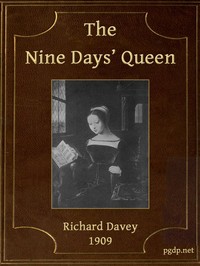
The Nine Days' Queen, Lady Jane Grey, and Her Times — A Closer Reading
(0 User reviews)
322
Project Gutenberg
2015
Not confirmed
Queens -- Great Britain -- Biography; Grey, Jane, Lady, 1537-1554; Great Britain -- Kings and rulers -- Succession -- History -- 16th century
Readers of public-domain and historical texts
Project Gutenberg digital edition
en
Edition facts
Words
161,698
Reading time
704 min
Text sections
35
For The Nine Days' Queen, Lady Jane Grey, and Her Times — A Closer Reading, the stored edition analysis reports 161,698 words, 11 hr 44 min estimated reading time, and 35 detected text sections.
The text analysis averages about 29.1 words per sentence, while the detected sections provide another way to judge how the source is divided.
Project Gutenberg metadata also associates the work with “Queens -- Great Britain -- Biography,” connecting these edition facts with the source record’s subject description.
Source:
Project Gutenberg record #50427
Richard Davey's biography of Lady Jane Grey foregrounds the conspiracies of the Howards, Seymours, and Northumberland that enabled her nine-day reign, using personal documents to illuminate the period's political intrigues.
Editorial Edition Score
4.9/5
★★★★★
★★★★★
Calculated from edition completeness, EPUB availability, text structure and catalogue metadata. Not a user rating.
How this score is calculated
- Description quality20 pts
- Title & short description10 pts
- Source metadata20 pts
- Text length15 pts
- Chapters / structure15 pts
- EPUB file integrity20 pts
Total of 100 points, scaled to a 2.5-5.0 range. Editions with an empty description or a missing EPUB file are not scored.
Edition quality
Public-domain source text
Read the source text
The source text is kept in the dedicated reader, separate from this catalogue record and its commentary.
Richard Davey’s biography of Lady Jane Grey opens not with the queen herself but with a chain of four conspiracies that, in his view, made her proclamation possible. The author states his intention to approach the story “from the personal rather than the political point of view,” leaning on what French historians call le document humain. This emphasis on intimate records—letters, eyewitness accounts, and private testimonies—shapes the narrative’s texture, as seen in the extended quotation from Francis Burgoyne’s letter to John Calvin describing the Duke of Somerset’s execution. Davey’s method is to let such documents carry the emotional weight, while he supplies connective analysis.
A Conspiracy-Driven Structure
Davey organizes his work around four sequential plots: the Howard-Catholic conspiracy against Katherine Parr; the Seymour campaign against the Howards; Thomas Seymour’s attempt to unseat his brother Edward; and finally John Dudley’s machinations to place Lady Jane on the throne. This architecture means that Lady Jane herself remains “a shadowy part” in early chapters, as the author acknowledges. The structure deliberately delays her entrance to build context, treating her story as the culmination of a decade of aristocratic maneuvering. Readers should expect a narrative that moves from court intrigue to court intrigue, with Jane’s personal tragedy emerging only after the political stage is fully set.
Recurring Images of Execution and Attire
The excerpts contain a striking recurring image: the condemned man’s final appearance. Somerset is described as “splendidly attired” at his execution, giving away gold rings and his clothes. Burgoyne’s letter notes that he was dressed “as he used to be when about to attend upon the King.” This attention to clothing in the face of death—a kind of sartorial dignity—appears to be a motif Davey draws from his sources. The detail of the executioner receiving rings from the prisoner’s fingers is vivid and specific. Such moments, drawn from le document humain, give the political narrative a tangible, human texture, contrasting the abstract conspiracies with the physical reality of their consequences.
Movement Between Public and Private Spaces
The narrative shifts frequently between the council chamber and the prison cell, between London and the continent. Burgoyne’s letter, written from London to Calvin in Geneva, exemplifies this movement: it reports a public execution witnessed by “many of my friends” and then analyzes Somerset’s character for a distant theological audience. Davey’s own voice moves similarly, from describing “the condition to which Henry VIII’s misrule had reduced the country” to quoting a foreign reformer’s intimate account. This back-and-forth creates a layered perspective, where English events are refracted through foreign eyes, and public acts are filtered through private correspondence.
The Author’s Judicious Ambivalence
Davey refrains from simple heroism or villainy. Of Somerset he writes that the duke was “neither entirely mediocre nor altogether great,” calling him un grand homme manqué—one who just missed greatness. Burgoyne’s letter, which Davey includes at length, is similarly balanced: it praises Somerset’s piety and gifts while noting his “excessive arrogance.” This willingness to let contradictory evidence stand—the duke as both God-fearing reformer and overreaching schemer—is characteristic of Davey’s approach. He does not resolve the tension but presents the documents and his own measured assessments, leaving readers to weigh the conflicting portraits of a man who “had no one here superior to him in any degree of honour” yet died on the block.
The Role of Foreign Observers
Davey frequently incorporates the perspectives of continental witnesses, such as the reformer Francis Burgoyne writing to John Calvin. These voices provide an external vantage point on English politics, often more detailed and less partisan than domestic accounts. Burgoyne’s letter includes a rumor that the Council offered Somerset a pardon, which he “rejected with contempt.” Such details, unconfirmed by other sources, add a layer of uncertainty that Davey does not smooth over. The inclusion of foreign correspondence enriches the narrative with alternative interpretations and underscores the international dimension of the Tudor power struggles.
Davey’s biography rewards readers who appreciate history built from primary sources. The author’s willingness to let documents speak—sometimes at length—means the narrative pace varies, with sudden shifts from analysis to raw testimony. Pay attention to the footnotes and quoted letters; they often contain the most arresting details. The book’s structure, moving through conspiracies before reaching Jane herself, requires patience but ultimately provides a thorough grounding in the political landscape that made her nine-day reign possible.
Reading about Lady Jane’s nine days, I kept noticing how the diaries around her felt less like politics and more like quiet family negotiations. It reminded me, strangely, of my own shelved notebooks. There’s a particular softness in Memories and Adventures — Reading Notes that echoes that same private voice, where history becomes less a verdict and more a murmur left between margins.
There are no reviews for this eBook.
There are no comments for this eBook.
Reader reflection
Take a moment to reflect on this book
Create a short personal record of your experience with this book.
Your progress
0
/
10
2
Was reading this book enjoyable?
3
Would you recommend this book to another reader?
4
What was the reading difficulty like?
5
Did the book give you something worth debating?
6
Did this book create an emotional response?
7
What did you think about the pace?
8
What did you appreciate most?
9
Which lesson or insight stayed with you?
10