1

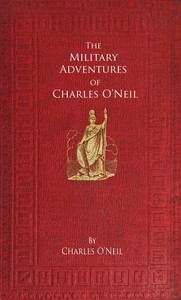
The Military Adventures of Charles O'Neil Who was a Soldier in the Army of Lord Wellington during the Memorable Peninsular War and the Continental Campaigns from — Context and Discussion
(0 User reviews)
393
Project Gutenberg
2018
Not confirmed
Europe -- History -- 1789-1815; Peninsular War, 1807-1814 -- Personal narratives, British; Waterloo, Battle of, Waterloo, Belgium, 1815 -- Personal narratives, British; O'Neil, Charles, 1793-; Barrosa, Battle of, Spain, 1811 -- Personal narratives, British
Readers of public-domain and historical texts
Project Gutenberg digital edition
en
Edition facts
Words
67,116
Reading time
292 min
Text sections
15
The catalog record for The Military Adventures of Charles O'Neil Who was a Soldier in the Army of Lord Wellington during the Memorable Peninsular War and the Continental Campaigns from — Context and Discussion provides practical reading context through 67,116 words, 4 hr 52 min estimated reading time, and 15 detected text sections.
The text analysis averages about 22.2 words per sentence, while the detected sections provide another way to judge how the source is divided.
Project Gutenberg metadata also associates the work with “Europe -- History -- 1789-1815,” connecting these edition facts with the source record’s subject description.
Source:
Project Gutenberg record #58307
Charles O'Neil, a common soldier in Wellington's army, recounts the Peninsular War and Waterloo with a focus on the ordinary soldier's experience, contrasting the glory of command with the horrors of battle.
Editorial Edition Score
4.8/5
★★★★★
★★★★★
Calculated from edition completeness, EPUB availability, text structure and catalogue metadata. Not a user rating.
How this score is calculated
- Description quality20 pts
- Title & short description10 pts
- Source metadata20 pts
- Text length15 pts
- Chapters / structure15 pts
- EPUB file integrity20 pts
Total of 100 points, scaled to a 2.5-5.0 range. Editions with an empty description or a missing EPUB file are not scored.
Edition quality
Public-domain source text
Read the source text
The source text is kept in the dedicated reader, separate from this catalogue record and its commentary.
Charles O'Neil, a private soldier in the British army, opens his memoir with a pointed critique of how generals treat men as 'blocks of wood, or movable machines.' His preface declares that the common soldier's feelings are as acute as those of commanders, and that true knowledge of war's evils comes only from following the rank and file through partings, wanderings, and suffering. This perspective shapes every page of his narrative, which covers the Peninsular War and Waterloo from 1811 to 1815.
A Soldier's View of Command and Sacrifice
O'Neil's preface explicitly sets his account apart from standard military histories. He writes that generals 'often calculate upon men as though they were blocks of wood,' and he aims to restore the humanity of those who actually win victories. This tension between the commander's strategic view and the soldier's lived experience recurs throughout the excerpts. At Barossa, O'Neil describes the British troops as exhausted by a twenty-two-hour march and a long fast, yet they fight with 'more bravery than before.' He notes that the Spanish General La Pena, three miles away, could hear every round of musketry but did not move to support his ally. O'Neil's indignation is palpable: La Pena 'listened neither to the voice of honor nor to the entreaties of his officers.' The contrast between the common soldier's sacrifice and the commander's inaction is a central pattern in the text.
The Immediate Aftermath: Roll Call and Burial
O'Neil devotes a striking passage to the scene after victory. The troops are summoned to the field, and he describes the 'saddened hearts' as they gaze on the dead. He notes that 'four hours ago, and there was not one, of all that now lay lifeless on that bloody field, whose heart did not beat as high as our own.' The roll call is a moment of deep pathos: 'name after name uttered without response.' O'Neil then lists the grim necessities: 'the hasty burial of the dead, and the hurried sending off the wounded, the surgeon's necessary operations, and the groans of the sufferers.' This passage contrasts sharply with the earlier excitement of battle, emphasizing that the 'horrors of war' are most vivid after the fighting stops. The structure—moving from the chaos of combat to the quiet, gruesome aftermath—is a deliberate choice that reinforces his anti-war message.
Allies and Enemies: Moral Ambiguity in the Field
O'Neil's account does not present a simple narrative of heroic British versus villainous French. At Barossa, the French are described as 'discomfited but not disheartened,' reforming and attacking repeatedly. The British fire is 'reserved until the enemy were close at hand,' and the execution is 'terrible.' Yet O'Neil also records the French leaders Ruffin and Rousseau falling 'mortally wounded,' and the French retreating with discipline. More striking is his treatment of the Spanish allies. He asks pointedly, 'where, during this conflict, were the Spanish troops, in whose cause the British were so freely lavishing, not only treasure, but their own lives?' He reports that La Pena later published a justification blaming the British commander Graham for 'disobedience of orders.' This inclusion of the ally's perspective complicates any simple patriotic reading, showing O'Neil's willingness to record inconvenient truths.
O'Neil's memoir is valuable not for strategic insight but for its unvarnished depiction of the soldier's lot. Readers should attend to the shifts between battle narrative and reflective commentary, as these reveal the author's purpose: to make the reader feel the weight of each casualty. The preface's promise to awaken compassion is fulfilled in the roll-call scene and the bitter account of La Pena's inaction. This is a document of witness, not glory.
Reading O'Neil's plain account of marching and mud, I remembered my grandfather’s stories—not of battles, but of the long waits between them. That quiet patience, the ordinary man’s endurance, felt echoed later in A Georgian Pageant, where history’s grand sweep is really just many small, weary days stitched together. A Georgian Pageant — Key Ideas to Explore brought back that same ache of recognizing quiet courage in unrecorded lives.
There are no reviews for this eBook.
There are no comments for this eBook.
Reader reflection
How did this book work for you?
Your answers remain private and are stored only in this browser.
Your progress
0
/
10
2
How much did you enjoy the reading experience?
3
Is this a title you would suggest to others?
4
How much effort did this book require?
5
Was the book easy to understand?
6
What was the strongest part of the book?
7
Did it raise ideas you would like to talk about?
8
How did the reading compare with what you expected?
9
What changed or sharpened your thinking?
10