1

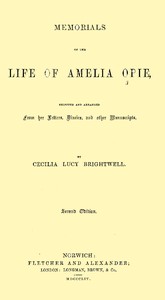
Memorials of the Life of Amelia Opie Selected and Arranged from her Letters, Diaries, and other Manuscripts — Edition Insights
(0 User reviews)
98
Project Gutenberg
2014
Not confirmed
Authors, English -- 19th century -- Biography; Opie, Amelia, 1769-1853; Opie, Amelia, 1769-1853 -- Correspondence
Readers of public-domain and historical texts
Project Gutenberg digital edition
en
Edition facts
Words
142,741
Reading time
621 min
Text sections
18
Memorials of the Life of Amelia Opie Selected and Arranged from her Letters, Diaries, and other Manuscripts — Edition Insights can be approached with a clearer sense of reading commitment from its source measurements: 142,741 words, 10 hr 21 min estimated reading time, and 18 detected text sections.
The text analysis averages about 22.0 words per sentence, while the detected sections provide another way to judge how the source is divided.
Project Gutenberg metadata also associates the work with “Authors, English -- 19th century -- Biography,” connecting these edition facts with the source record’s subject description.
Source:
Project Gutenberg record #47595
C. L. Brightwell's compilation of Amelia Opie's letters, diaries, and papers reveals a writer navigating literary fame, Quaker faith, and personal loss. The volume captures Opie's social energy, her grief after her husband's death, and the tension between public engagement and private solitude.
Editorial Edition Score
4.8/5
★★★★★
★★★★★
Calculated from edition completeness, EPUB availability, text structure and catalogue metadata. Not a user rating.
How this score is calculated
- Description quality20 pts
- Title & short description10 pts
- Source metadata20 pts
- Text length15 pts
- Chapters / structure15 pts
- EPUB file integrity20 pts
Total of 100 points, scaled to a 2.5-5.0 range. Editions with an empty description or a missing EPUB file are not scored.
Edition quality
Public-domain source text
Read the source text
The source text is kept in the dedicated reader, separate from this catalogue record and its commentary.
Amelia Opie's own voice emerges most vividly in the letters and journal entries that form the backbone of this memorial volume. The editor, Cecilia Lucy Brightwell, explains in the preface that Opie left no autobiography, only a mass of papers, and that the task of selection fell to her executor. The resulting work is neither a continuous narrative nor a simple collection; it is a mosaic in which Opie's direct words—often addressed to a single friend—alternate with Brightwell's bridging commentary. The reader encounters Opie as a woman who, in 1827, could write that 'solitude, prolonged solitude, preyed upon her spirits' even as she attended the Yearly Meeting of the Society of Friends and dined with the Duke of Gloucester. That juxtaposition of social delight and private ache runs through the entire volume.
A Life in Letters and Diaries
The materials from which these memoirs are compiled are, as Brightwell states, 'principally Papers, Letters, and Diaries, of Mrs. Opie's own writing.' The editor notes that a very large number of letters received by Opie were found among her papers, but she and her father chose not to make free use of them, hoping to avoid violations of private and confidential communications. This editorial restraint shapes the volume: Opie's own words dominate, but the reader sees her largely through her own self-presentation. The result is a portrait that feels intimate yet incomplete, as Brightwell herself acknowledges that Opie 'seems to have made some efforts at commencing' an autobiography but left it unfinished. The letters, however, give a sense of immediate presence—Opie describing a bazaar for schools in St. Giles', or recalling that a friend remembered far more of her story 'Odd-tempered Man' than she did herself.
The Social World and Its Costs
Opie's letters from London in 1827 show her moving through a dense network of acquaintances: she attends the African Meeting at Freemason's Tavern, hears Lord Roden expound Scripture, and calls on Lady Cork. She notes that the Duke of Gloucester 'talked some time, retaining my hand in his' and adds a parenthetical hope that 'friends behind were not scandalized.' Yet this social energy is shadowed by loss. In the same letter, she confesses that 'my life, during the last three weeks in London, has realized my loss to me more than ever'—a reference to her husband's death. The pattern recurs: Opie's 'essentially social nature' thrives in company, but solitude 'preyed upon her spirits.' The volume repeatedly returns to this tension, as when Brightwell observes that Opie bore up against 'painful regrets and memories of the past' and that 'the effort was beneficial.'
Faith, Reform, and Literary Echoes
Opie's Quaker commitments appear throughout the excerpts. She attends the Yearly Meeting of the Society of Friends, and her journal entries note meetings of the Bible, British and Foreign School, and Anti-Slavery Societies. Brightwell remarks on the 'cordial interest' Opie always evinced on these occasions, and how 'her eye kindled as she recalled the eloquent address of some friend of the wronged and helpless.' Yet literary fame is never far away. An American lady introduces herself, mentioning that Sir Walter Scott's niece is staying with her, and tells Opie that her story 'Odd-tempered Man' had reformed a dear friend. Opie's own reaction—'sweet food for vanity, and I hope also for some better feeling'—captures the blend of self-awareness and moral seriousness that marks her letters. The volume thus presents a woman who is at once a celebrated author, a devout Friend, and a widow navigating memory and public life.
Readers approaching this volume should expect a work that is part biography, part archive. Brightwell's editorial hand is light but purposeful: she arranges Opie's papers to highlight the arc of a life without forcing a single narrative. The result rewards those who enjoy tracing a personality through fragmentary evidence—a phrase in a letter, a diary entry about a meeting, a remembered gesture. Opie herself, in her farewell address, expressed confidence that her executors would 'do everything for the best.' This memorial is the result of that trust, and it invites the reader to share in the work of piecing together a life from its own remains.
There’s something tender about how Amelia Opie’s letters hold both the crowded rooms and the quiet afterward—the same hush I felt reading Random Shots from a Rifleman — Edition Insights. These old collections feel like borrowing someone’s handwriting for an afternoon, and I’m always a little sad when the last page turns.
There are no reviews for this eBook.
There are no comments for this eBook.
Reader reflection
Record your reading impressions
A brief reflection can help important ideas stay with you longer.
Your progress
0
/
10
2
Was reading this book enjoyable?
3
How likely are you to recommend this book?
4
How demanding did the text feel?
5
How closely did the book connect with your experience?
6
How useful were the ideas in this book?
7
Which aspect of the book did you value most?
8
How understandable was the text?
9
What changed or sharpened your thinking?
10