1

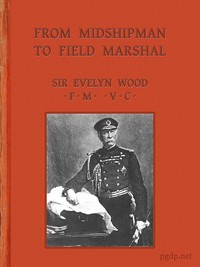
From Midshipman to Field Marshal — A Reader’s Guide
(0 User reviews)
537
Project Gutenberg
2020
Not confirmed
Marshals -- Great Britain -- Biography; Great Britain -- History, Military -- 19th century; Wood, Evelyn, 1838-1919
Readers of public-domain and historical texts
Project Gutenberg digital edition
en
Edition facts
Words
243,930
Reading time
1061 min
Text sections
60
Before opening From Midshipman to Field Marshal — A Reader’s Guide, the edition data offers a quick orientation: 243,930 words, 17 hr 41 min estimated reading time, and 60 detected text sections.
The text analysis averages about 23.6 words per sentence, while the detected sections provide another way to judge how the source is divided.
Project Gutenberg metadata also associates the work with “Marshals -- Great Britain -- Biography,” connecting these edition facts with the source record’s subject description.
Source:
Project Gutenberg record #61812
Evelyn Wood's memoir traces his career from Royal Navy midshipman to field marshal, with detailed accounts of the Crimean War, Indian Mutiny, Ashanti, Zulu, and Egyptian campaigns. The excerpts show his focus on logistics, equipment failures, and personal interactions with commanders like General Thesiger.
Editorial Edition Score
4.9/5
★★★★★
★★★★★
Calculated from edition completeness, EPUB availability, text structure and catalogue metadata. Not a user rating.
How this score is calculated
- Description quality20 pts
- Title & short description10 pts
- Source metadata20 pts
- Text length15 pts
- Chapters / structure15 pts
- EPUB file integrity20 pts
Total of 100 points, scaled to a 2.5-5.0 range. Editions with an empty description or a missing EPUB file are not scored.
Edition quality
Public-domain source text
Read the source text
The source text is kept in the dedicated reader, separate from this catalogue record and its commentary.
Evelyn Wood’s memoir opens with a dedication “to my comrades past and present of all ranks in both services,” signaling a narrative that blends personal advancement with collective military experience. The table of contents reveals a career spanning from 1852 aboard HMS Queen to command of the Second Army Corps in 1903, with each chapter anchored to a specific campaign or posting. The excerpts show Wood’s attention to administrative detail: he notes that the 90th Light Infantry landed with only four flannel shirts and four mess tins, and that soldiers were sent to the front unarmed and unclothed. This is not a romantic war story but a practical officer’s account of how armies actually function—and malfunction.
A Career in Two Services
The title From Midshipman to Field Marshal is literal: Wood began as a naval officer on a 116-gun ship before transferring to the army. The chapter list shows he served in the Crimea with the 13th Light Dragoons, then in Central India during the Mutiny, and later commanded the 90th Light Infantry in South Africa. His path is not a straight line but a series of postings that reflect the British Empire’s military commitments. The excerpts give a sense of how Wood moved between theaters, always observing the state of his troops. In Zululand, he notes that General Thesiger, a teetotaler, brought champagne to a meeting—a small detail that humanizes command relations. Wood’s voice is that of a man who has seen both the grand strategy and the broken boots.
The Logistics of Empire
Wood repeatedly returns to the theme of inadequate equipment. In the Amatola Mountains, he finds his battalion poorly supplied; later, inspecting the left wing at Utrecht, he discovers the regimental reserve consisted of “four flannel shirts, and four mess tins.” He pushes for reform, and after his representations, General Thesiger supports a policy that no soldier should leave the base without proper gear. Yet when Wood returns to Natal in 1881, he finds battalions have “slipped back to the old state of unreadiness,” with men having only one partly worn pair of boots. These observations are not complaints but evidence of a systemic problem: the regimental system left supplies in the quartermaster’s hands, and Wood argues that someone had to speak out. His memoir thus serves as a corrective to official histories that gloss over such failures.
Negotiation and Command in the Field
An extended excerpt describes Wood’s dealings with the Pondo chief Umquikela in 1878. Wood agrees to a meeting, then waits while the chief delays. Mrs. Jenkins, playing “Sister Anne” in Blue Beard, spots the chief’s party on a hill, but Umquikela refuses to come closer. After hours of messages, Wood rides 40 miles back to Kokstadt before daylight, then proceeds to the Ixopo, where General Thesiger joins him. They talk through the night about the Pondos and the magistrates. The episode shows Wood’s patience and his willingness to travel hard distances—and it reveals the odd juxtaposition of imperial formality and frontier improvisation. The mention of a children’s game as a signal is a rare moment of dark humor in a text otherwise focused on supply and strategy.
Voice and Structure: A Practical Memoir
Wood writes in a plain, factual style, with dates and place names anchoring each paragraph. He rarely editorializes; instead, he lets details speak. The narrative moves chronologically, but within chapters he often jumps between administrative work, combat, and social interactions. The excerpts show a man who values efficiency: he calculates costs (30s. per diem per wagon), proposes a regimental transport scheme costing £60,000, and notes that his suggestions were carried out. Yet he also records personal moments, like the late-night talk with Thesiger. This combination of bureaucratic precision and human observation gives the memoir its texture. Readers should expect a work that is less about heroism than about how the British army actually operated—and how one officer tried to make it work better.
Wood’s memoir rewards readers who attend to the small details: the number of shirts in a reserve store, the cost of a wagon, the route of a night ride. These are the building blocks of his argument that military readiness depends on mundane logistics. The book is long—over 240,000 words—but its chapters are self-contained, making it possible to read selectively. For a first reading, the chapters on the Zulu campaign (XXVIII–XXXIV) offer a concentrated example of Wood’s method: a mix of personal narrative, administrative critique, and sharp observation of both allies and enemies.
I kept thinking about Wood’s quiet patience with broken equipment and stubborn generals. It felt less like adventure and more like endurance. That same deep, steady honesty lives in Fisher’s memories—he never hides the mess, just watches it with a wry calm. Memories, by Admiral of the Fleet, Lord Fisher — Reading Companion carried that weight with me for days, like an old friend’s tired shrug after a long war.
There are no reviews for this eBook.
There are no comments for this eBook.
Reader reflection
How did this book work for you?
Your answers remain private and are stored only in this browser.
Your progress
0
/
10
2
Did this book hold your interest?
3
Would you pass this book on to a friend?
4
How much effort did this book require?
5
Which part made the strongest impression?
6
How understandable was the text?
7
Did it raise ideas you would like to talk about?
8
Did the book meet your expectations?
9
What is the main idea you are taking away?
10