1

The Life and Labors of Elias Hicks — Context and Discussion
(0 User reviews)
719
Project Gutenberg
2015
Not confirmed
Quakers -- Biography; Hicks, Elias, 1748-1830; Hicks family
Readers of public-domain and historical texts
Project Gutenberg digital edition
en
Edition facts
Words
77,727
Reading time
338 min
Text sections
10
This digital edition of The Life and Labors of Elias Hicks — Context and Discussion is described by source-level measurements including 77,727 words, 5 hr 38 min estimated reading time, and 10 detected text sections.
The text analysis averages about 23.9 words per sentence, while the detected sections provide another way to judge how the source is divided.
Project Gutenberg metadata also associates the work with “Quakers -- Biography,” connecting these edition facts with the source record’s subject description.
Source:
Project Gutenberg record #50374
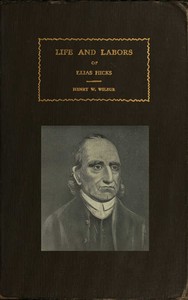
Henry W. Wilbur's 1910 biography of Elias Hicks (1748–1830) draws on letters, sermons, and meeting records to present the Quaker minister as his own interpreter amid the 1820s Hicksite controversy. The preface disavows reconciling conflicting estimates, and excerpts show doctrinal disputes over Christ's divinity and human equality with God.
Editorial Edition Score
4.8/5
★★★★★
★★★★★
Calculated from edition completeness, EPUB availability, text structure and catalogue metadata. Not a user rating.
How this score is calculated
- Description quality20 pts
- Title & short description10 pts
- Source metadata20 pts
- Text length15 pts
- Chapters / structure15 pts
- EPUB file integrity20 pts
Total of 100 points, scaled to a 2.5-5.0 range. Editions with an empty description or a missing EPUB file are not scored.
Edition quality
Public-domain source text
Read the source text
The source text is kept in the dedicated reader, separate from this catalogue record and its commentary.
Henry W. Wilbur opens his 1910 biography with a frank admission: Elias Hicks was “a much misunderstood man in his own time,” and the eighty years since his death had done little to clarify his legacy. Rather than reconcile the conflicting estimates of saint and malevolent influence, Wilbur aims to present Hicks “as he was, in his own environment,” letting him become “largely his own interpreter” through private correspondence and public utterance. The excerpts that follow bear out this method, offering a dense record of doctrinal controversy, disciplinary procedure, and personal testimony from the 1820s, when Hicks faced formal charges from ten Philadelphia elders.
A Biography Framed by Controversy
The table of contents reveals a work structured around conflict: chapters on “First Trouble in Philadelphia,” “The Time of Unsettlement,” “The Braithwaite Controversy,” and “Disownment and Doctrine” occupy nearly half the volume. Wilbur does not hide the partisan nature of his sources. The preface states that “warm personal friends” considered Hicks “little less than a saint,” while enemies believed his influence “malevolent and mischievous.” The author’s stated hope is to avoid making Hicks conform to either estimate, yet the excerpts—dominated by letters, signed statements, and meeting minutes—show a biography built from the paper trail of a religious quarrel. The 1822 letter from ten elders and Hicks’s reply, reproduced in full, give the reader direct access to the language of accusation and defense.
Doctrinal Disputes in the Excerpts
The excerpts center on a single theological flashpoint: whether Hicks taught that man could become equal with God. A signed statement by three members of Southern Quarterly Meeting corrects the charges point by point. They affirm that Hicks said Jesus “had no more power given him than man” is incorrect, and that “man being obedient to the spirit of God in him could arrive at as great or greater degree of righteousness than Jesus Christ” is likewise incorrect. But they also defend Hicks’s actual words: “this stone or seed in man had all the attributes of the divine nature that was in Christ and God.” The statement concludes that Hicks’s sentiments were “agreeable to the opinions and doctrines held by George Fox and other worthy Friends of his time.” This careful parsing of what Hicks did and did not say is the closest the excerpts come to a doctrinal summary.
The Limits of the Record
Despite the wealth of documentary evidence, the excerpts offer only a partial view. The biography’s twenty-five chapters range from “Ancestry and Boyhood” to “Putting off the Harness,” but the provided text is almost entirely drawn from the controversy of 1822–1828. There is no sample of Hicks’s early ministry, his family life at Jericho, his letters to his wife, or his later years. The reader cannot assess Wilbur’s handling of the slavery question (chapter XI) or the “Various Opinions” (chapter XII). The biography’s claim to let Hicks speak for himself is tested by the excerpts, which show him speaking mainly in defensive mode. The full work may well balance this with other voices, but the evidence here is overwhelmingly forensic.
Readers approaching this biography should expect a work that foregrounds institutional conflict and theological hair-splitting. The excerpts suggest that Wilbur’s method is to let documents—letters, meeting minutes, signed statements—carry the narrative, with minimal authorial gloss. Those interested in the mechanics of Quaker discipline or the specific doctrinal arguments of the Hicksite controversy will find rich material. Those seeking a rounded portrait of Hicks’s daily life, family, or later reputation may need to look beyond the provided chapters.
Reading Wilbur's patient work with Elias Hicks, where every sermon and letter contests another’s account, I felt how much of a life resists tidy judgment. It made me think of James Brooke, another man whose own words were endlessly reframed by others. There is a particular loneliness in that. Rajah Brooke — Key Ideas to Explore holds similar quiet tensions.
There are no reviews for this eBook.
There are no comments for this eBook.
Reader reflection
Record your reading impressions
A brief reflection can help important ideas stay with you longer.
Your progress
0
/
10
2
Did this book hold your interest?
3
How likely are you to recommend this book?
4
How demanding did the text feel?
5
Could you apply anything you learned?
6
How well did it match your expectations?
7
How clearly were the main ideas presented?
8
Would a second reading be valuable?
9
What is the main idea you are taking away?
10