1

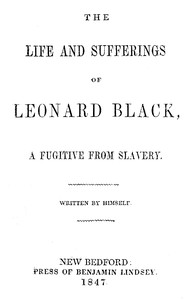
The Life and Sufferings of Leonard Black, a Fugitive from Slavery — Reading Companion
(0 User reviews)
876
Project Gutenberg
2021
Not confirmed
Fugitive slaves -- United States -- Biography; African Americans -- Biography; Black, Leonard, 1822-1883
Readers of public-domain and historical texts
Project Gutenberg digital edition
en
Edition facts
Words
13,090
Reading time
57 min
Text sections
2
The source record for The Life and Sufferings of Leonard Black, a Fugitive from Slavery — Reading Companion measures this digital text at 13,090 words, 57 min estimated reading time, and 2 detected text sections.
The text analysis averages about 17.9 words per sentence, while the detected sections provide another way to judge how the source is divided.
Project Gutenberg metadata also associates the work with “Fugitive slaves -- United States -- Biography,” connecting these edition facts with the source record’s subject description.
Source:
Project Gutenberg record #65033
Leonard Black's 1847 narrative, written by himself with editorial assistance, recounts his over twenty years of slavery in Maryland and his escape. The text blends plain-spoken testimony with biblical allusion, and its pacing shifts between rapid chronicle and reflective passages, notably after a severe accident.
Editorial Edition Score
4.5/5
★★★★★
★★★★★
Calculated from edition completeness, EPUB availability, text structure and catalogue metadata. Not a user rating.
How this score is calculated
- Description quality20 pts
- Title & short description10 pts
- Source metadata20 pts
- Text length15 pts
- Chapters / structure15 pts
- EPUB file integrity20 pts
Total of 100 points, scaled to a 2.5-5.0 range. Editions with an empty description or a missing EPUB file are not scored.
Edition quality
Public-domain source text
Read the source text
The source text is kept in the dedicated reader, separate from this catalogue record and its commentary.
Leonard Black’s 1847 narrative opens with a direct address to the reader, promising “a plain, simple narrative of the more interesting portion of my life, while in slavery.” The voice is unadorned but carries a rhythmic, almost sermonic cadence, as when he likens his deliverance to God’s rescue of Israel “with a strong hand and an outstretched arm.” The text is shaped by two hands: Black’s own, and that of an unnamed editor who corrected orthography and punctuation while aiming to preserve the story “as nearly unchanged as possible.” This editorial layer is acknowledged in a prefatory notice by A. M. Macy, who vouches for Black’s truthfulness. The result is a hybrid document—part testimony, part spiritual autobiography—where the narrator’s plain speech is occasionally interrupted by longer, more reflective passages that slow the pace and deepen the emotional register.
A Voice Between Plainness and Preaching
Black’s narrative voice shifts between two registers. In the opening chapters, he recounts events in swift, declarative sentences: “I was born in Annarundel County … lived a slave more than twenty years.” The tone is matter-of-fact, even when describing the sale of his mother and sister. But as the story progresses, the voice becomes more explicitly religious. After breaking his leg in a canal-boat accident, Black hears an internal rebuke—“This is for your disobedience”—and later quotes Paul’s injunction to “give thanks.” These biblical insertions are not ornamental; they structure his understanding of suffering. The editor’s hand is visible in the punctuation and paragraph breaks, but the underlying idiom—colloquial, earnest, occasionally repetitive—remains Black’s. Readers should attend to these tonal shifts, as they mark moments where the narrator steps back from mere chronology to interpret his experience.
Pace and the Weight of Accident
The narrative’s pace is uneven. Early chapters move quickly through years of bondage, with little dwelling on individual episodes. But the account of Black’s accident—a horse falling on him, breaking his leg, leaving him bedridden—slows to a near halt. Details accumulate: the rain, the dark, the horse’s hind legs giving way, the four-hour wait for a doctor, the nineteen-mile carriage ride home. This sudden expansion of time mirrors the narrator’s own immobilization. The accident becomes a pivot, after which the story turns from external events to internal struggle. Black describes his “distress of body” and “anguish of mind,” noting that his family had little food and his wife was unwell. The pacing here is not just a stylistic choice; it reflects the way trauma disrupts the forward momentum of a life.
Biblical Language as a Framework for Suffering
Throughout the excerpts, Black uses biblical language not as decoration but as a lens for making sense of his trials. He compares his escape from slavery to the Exodus, and after his accident he recalls Paul’s words from Thessalonians. These references are woven into the narrative rather than appended as moral lessons. The effect is to frame personal suffering within a larger providential story. Black’s own voice merges with scriptural echoes, especially when he questions his calling to preach: “I know that I am of a slow tongue, and unlearned; but what says the prophet Zachariah?” This interweaving of testimony and scripture gives the narrative a dual texture—part memoir, part sermon. Readers should note how the biblical quotations function less as proof-texts than as a language of consolation and self-justification.
This edition preserves the original 1847 text, including the prefatory notice and introduction. Readers may wish to compare the narrative’s plainspoken sections with its more reflective, sermon-like passages, as the contrast reveals how Black negotiated his dual identity as a fugitive and a preacher. The editorial intervention, though light, is worth noting: it shapes the text’s readability without obscuring the author’s distinctive voice.
That rainy afternoon, Leonard Black’s plain-spoken testimony stayed with me long after I closed it—his quiet persistence through suffering felt less like history, more like company. Later, idly scanning shelves, my hand landed on Records, by Admiral of the Fleet, Lord Fisher — Edition Insights, and I found the same unhurried honesty, just from a different deck. One voice carries scars; the other, salt. Both simply endure. I read until the window darkened.
There are no reviews for this eBook.
There are no comments for this eBook.
Reader reflection
What did you think of this book?
Answer a few questions and save a private reflection on this device.
Your progress
0
/
10
2
Did this book hold your interest?
3
How likely are you to recommend this book?
4
How demanding did the text feel?
5
Did the book give you something worth debating?
6
How did the reading compare with what you expected?
7
How would you describe its reading pace?
8
Which aspect of the book did you value most?
9
What is the main idea you are taking away?
10