1

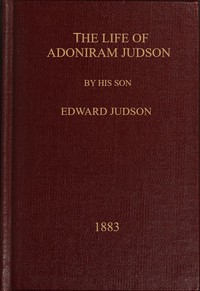
The life of Adoniram Judson — Text and Context
(0 User reviews)
341
Project Gutenberg
2023
Not confirmed
Missionaries -- United States -- Biography; Judson, Adoniram, 1788-1850; Missionaries -- Burma -- Biography
Readers of public-domain and historical texts
Project Gutenberg digital edition
en
Edition facts
Words
227,799
Reading time
991 min
Text sections
35
This digital edition of The life of Adoniram Judson — Text and Context is described by source-level measurements including 227,799 words, 16 hr 31 min estimated reading time, and 35 detected text sections.
The text analysis averages about 21.1 words per sentence, while the detected sections provide another way to judge how the source is divided.
Project Gutenberg metadata also associates the work with “Missionaries -- United States -- Biography,” connecting these edition facts with the source record’s subject description.
Source:
Project Gutenberg record #70894
Edward Judson's biography of his father, Adoniram Judson, draws on letters and journals to present the missionary's personal struggles, including his grief, self-doubt, and isolation in Burma, through his own candid words.
Editorial Edition Score
4.9/5
★★★★★
★★★★★
Calculated from edition completeness, EPUB availability, text structure and catalogue metadata. Not a user rating.
How this score is calculated
- Description quality20 pts
- Title & short description10 pts
- Source metadata20 pts
- Text length15 pts
- Chapters / structure15 pts
- EPUB file integrity20 pts
Total of 100 points, scaled to a 2.5-5.0 range. Editions with an empty description or a missing EPUB file are not scored.
Edition quality
Public-domain source text
Read the source text
The source text is kept in the dedicated reader, separate from this catalogue record and its commentary.
Edward Judson, writing as a son, frames this biography not as a theory of missions but as a 'clear and consecutive story' of his father's life, drawing heavily on Adoniram Judson's letters and journals. The narrative voice shifts between filial reverence and the raw, unguarded tone of the missionary's own prose. Judson's letters reveal a man who describes himself as living 'alone' in a cottage 'away from the haunts of men,' haunted by past failures and longing for 'real communion with God.' The biography thus becomes a study in contrasts: the public figure of a pioneering missionary and the private individual wrestling with doubt and desolation.
A Son’s Editorial Hand
Edward Judson openly acknowledges his editorial choices: he has 'introduced large extracts from his letters and journals' and, in a few places, taken 'the liberty of condensing.' This method gives the reader direct access to Adoniram Judson’s voice, but the condensation means that the son’s shaping hand is always present. The dedication 'to the children of missionaries' signals an intended audience that shares the experience of inheriting both suffering and reward. The biography is thus a personal project, not a detached scholarly account.
The Vocabulary of Desolation
Adoniram Judson’s letters are marked by a recurring lexicon of isolation and spiritual struggle. He writes of 'the desolate state of my own mind,' of grief that 'combines with sorrow for present sin,' and of God as 'the Great Unknown.' His metaphors are striking: he describes his past years as 'spectres to haunt my soul' that 'shake the chains they have riveted on me.' Even his dog, Fidelia, becomes a symbol of loss, as he anticipates shedding 'more than one tear when poor Fidee goes.' These word choices reveal a man who experiences faith as a painful, often elusive pursuit.
Structure Through Anniversaries
The biography uses temporal markers to structure Judson’s emotional life. Letters are dated to anniversaries—'the second anniversary of the triumph of death' and 'the third anniversary'—that anchor his grief in specific, recurring moments. This structural choice emphasizes the cyclical nature of his sorrow, as he returns to the same cottage and the same themes year after year. The reader sees not a linear progression toward resolution but a persistent, unresolved ache that deepens the portrait of the man behind the missionary.
The Unadorned Self-Portrait
Judson’s self-descriptions are remarkably candid and unheroic. He calls himself an 'unworthy brother' and admits to 'inveterate habits' and 'a long course of religious sinning.' He begs younger missionaries not to 'live as I have done.' This willingness to expose failure and doubt is a deliberate authorial choice, preserved by his son in the biography. The effect is to present a figure whose authority comes not from certainty but from the raw honesty of his struggle, making the narrative more intimate and less hagiographic than many contemporary accounts.
Readers approaching this biography should attend to the interplay between Edward Judson’s framing and his father’s raw words. The son’s editorial decisions—what to include, what to condense—shape the portrait, but the letters themselves offer a direct, unfiltered voice. The biography is best read as a layered document: a son’s tribute that nonetheless allows the father’s doubt, grief, and longing to speak plainly. It rewards those who listen for the tensions between public legacy and private anguish.
There are books that follow you quietly, like a low tide pulling at your thoughts. Judson’s letters, stripped of pretense, feel that way—his loneliness becomes yours for a while. I found a similar ache of human endurance in The Life and Reign of Edward I. — Edition Insights, though its weight is more crown than cross. Both left me sitting in silence, not quite ready to move on.
There are no reviews for this eBook.
There are no comments for this eBook.
Reader reflection
How will you remember this book?
Save your reaction, strongest insight, and memorable passage.
Your progress
0
/
10
2
What was your overall reaction to the book?
3
Would you recommend this book to another reader?
4
How demanding did the text feel?
5
How did the reading compare with what you expected?
6
What was the strongest part of the book?
7
Did anything about the book feel genuinely new?
8
How useful were the ideas in this book?
9
What did this book teach you most?
10