1

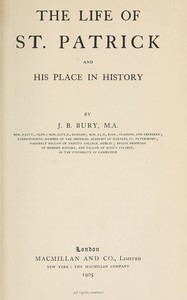
The life of St. Patrick and his place in history — Reading Companion
(0 User reviews)
1180
Project Gutenberg
2023
Not confirmed
Patrick, Saint, 373?-463?; Christian saints -- Ireland -- Biography; Ireland -- Church history -- To 1172
Readers of public-domain and historical texts
Project Gutenberg digital edition
en
Edition facts
Words
135,776
Reading time
591 min
Text sections
31
The life of St. Patrick and his place in history — Reading Companion can be approached with a clearer sense of reading commitment from its source measurements: 135,776 words, 9 hr 51 min estimated reading time, and 31 detected text sections.
The text analysis averages about 20.0 words per sentence, while the detected sections provide another way to judge how the source is divided.
Project Gutenberg metadata also associates the work with “Patrick, Saint, 373?-463?,” connecting these edition facts with the source record’s subject description.
Source:
Project Gutenberg record #71431
J.B. Bury's 1905 biography applies rigorous source criticism to Patrick's life, treating it as a Roman frontier study. The preface reveals Bury's methodical approach, comparing Patrick to other European missionaries and critiquing prior scholarship for lacking systematic Quellenkritik.
Editorial Edition Score
4.9/5
★★★★★
★★★★★
Calculated from edition completeness, EPUB availability, text structure and catalogue metadata. Not a user rating.
How this score is calculated
- Description quality20 pts
- Title & short description10 pts
- Source metadata20 pts
- Text length15 pts
- Chapters / structure15 pts
- EPUB file integrity20 pts
Total of 100 points, scaled to a 2.5-5.0 range. Editions with an empty description or a missing EPUB file are not scored.
Edition quality
Read the Text
hich this religion derived, for the acceleration of its progress, from its acceptance by the head of the Roman State. But while it is evident that the Church gained immeasurably within the Empire by her sudden exaltation, it is perhaps generally overlooked how her changed position aided Christianity to pass out beyond the Empire’s borders. We touch here on a fact of supreme importance—not less important, but more likely to escape notice, because it cannot be stated in terms of definite occurrences:—the enormous prestige which the Roman Empire possessed in the minds of the barbarian peoples who dwelt beyond it. The observant student who follows with care the history of the expansion of Germany and the strange process by which the German kingdoms were established within the Empire in western Europe, is struck at every step by the profound respect which the barbarians evinced for the Empire and the Roman name throughout all their hostilities and injuries. While they were unconsciously dismembering it, they believed in its impregnable stability; Europe without the Empire was unimaginable; the dominion of Rome seemed to them part of the universal order, as eternal as the great globe itself. If we take into account this immeasurable reverence for Rome, which is one of the governing psychical facts in the history of the “wandering of the nations,” we can discern what prestige a religion would acquire for neighbouring peoples when it became the religion of the Roman people and the Roman State. We can understand with what different eyes the barbarians must have regarded Christianity when it was a forbidden and persecuted doctrine and when it was raised to be a State religion. It at once acquired a claim on their attention; it was no longer merely one among many rival doctrines current in the Empire. Considerations of political advantage came in; and political motives could sway barbarians, no less than Constantine himself, in determining their attitude to a religious creed. And the fact that the Christian God was the God of that great Empire was in itself a persuasive argument in his favour. Could a people find any more powerful protector than the Deity who was worshipped and feared by the greatest “nation” on earth? So it seemed to the Burgundians, who embraced the Roman religion, we are told,[8] because they conceived that “the God of the Romans is a strong helper to those who fear Him.” The simple barbarians did not reason too curiously. It did not occur to them that the Eternal City had achieved her greatness and built her empire under the auspices of Jupiter and Mars. There can be little doubt that, if the step taken by Constantine had been postponed for a hundred years, we should not find the Goths and the Vandals professing Christianity at the beginning of the fifth century.
[Sidenote: IRELAND NOT ISOLATED]
J.B. Bury opens his study of St. Patrick not with the saint himself but with a historiographical problem: the subject was 'wrapt in obscurity, and this obscurity was encircled by an atmosphere of controversy and conjecture.' The preface, written in a measured academic voice, positions Patrick as an appendix to Roman imperial history rather than a purely Irish figure. Bury's language is deliberate and self-aware, acknowledging that prior works—even Todd's respected study—lacked 'methodical Quellenkritik.' This sets a tone of cautious reconstruction, where every fact is suspect until sifted.
A Preface as Methodological Manifesto
The preface functions as a statement of scholarly intent. Bury explains that his interest arose from comparing Patrick to other missionaries like Cyril, Methodius, and Wulfilas, framing conversion as a European phenomenon. He criticizes Todd's St. Patrick for its 'radical vice': the absence of a systematic source-critical foundation. Bury's own approach is announced as beginning 'at the beginning, almost as if nothing had been done.' The voice is confident yet restrained, avoiding hagiographic flourishes. Notably, Bury admits that Todd's work left him 'doubtful about every fact,' a confession that underscores the difficulty of the task. This section reveals Bury's narrative strategy: he will build credibility by first dismantling previous certainties.
Folklore, Legend, and Historical Particles
In a passage on hagiographical stories, Bury distinguishes between popular imagination and historical tradition. He describes how legends were 'created by popular imagination, and suggested by the motives of folklore,' citing the story of the first Easter as a transference of Beltane customs. Yet he insists that genuine details—'like metallic particles'—are embedded within the myth. The example of the poet Dubthach at Tara is offered as a 'true historical tradition,' akin to Simon of Cyrene in the Crucifixion narrative. Bury's language here is analytical, parsing the layers of composition. He references Professor W. Meyer's remarks on hagiography as 'christliche Unterhaltungsliteratur,' noting that such texts aimed to produce 'a strong impression' on the faithful. This section shows Bury's method: he treats legends as artifacts to be dissected, not dismissed.
The Mechanics of Source Comparison
Bury's technical discussion of the Vita Secunda and Vita Quarta exemplifies his critical apparatus. He describes a 'close parallelism' between the two anonymous Lives, both dependent on a common source he designates W. The comparison reveals that neither document derives from the other; instead, W was 'sometimes a free paraphrase, sometimes a close copy' of Muirchu's Life. Bury notes that V₂ stops abruptly after the Tara episode, while V₄ is 'rather more prolix.' He points to Irish sentences in V₂ that appear only in Latin equivalents in V₄. This granular analysis, drawn from his 1902 paper in Hermathena, demonstrates Bury's commitment to reconstructing textual lineages. The prose is dense with sigla and cross-references, reflecting a scholar's patience with minutiae.
Bury's biography demands patience from its reader. The narrative pace is uneven: the preface moves deliberately, while later sections accelerate into technical source criticism. Readers should expect extended passages on manuscript relationships and historiographical debate. The reward is a portrait of Patrick built not on legend but on the careful weighing of evidence. Bury never claims certainty; he offers probabilities. This orientation—toward method over myth—makes the work a landmark in historical biography, though it may frustrate those seeking a straightforward life story.
There’s something humbling in how Bury turns Patrick into a frontier administrator, patient with sources, wary of legend. It reminds me of old childhood books, where history felt like a story someone was still telling—like Peter Parley's Own Story From the Personal Narrative of the Late Samuel G. Goodrich, ("Peter Parley") — Key Ideas to Explore. Both ask me to trust the teller, yet leave room for wonder.
There are no reviews for this eBook.
There are no comments for this eBook.
Reader reflection
How will you remember this book?
Save your reaction, strongest insight, and memorable passage.
Your progress
0
/
10
2
What was your overall reaction to the book?
3
Would you encourage someone else to read it?
4
How much effort did this book require?
5
Did the book meet your expectations?
6
Would a second reading be valuable?
7
How would you rate its originality?
8
How understandable was the text?
9
Which lesson or insight stayed with you?
10