1

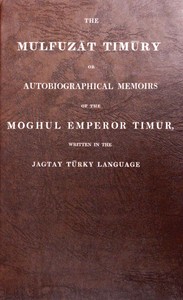
The Mulfuzāt Timūry = — Background and Themes
(0 User reviews)
2092
Project Gutenberg
2025
Not confirmed
Timur, 1336-1405 -- Early works to 1800; Asia, Central -- History; Asia, Central -- Kings and rulers -- Biography
Readers of public-domain and historical texts
Project Gutenberg digital edition
en
Edition facts
Words
84,987
Reading time
370 min
Text sections
33
The catalog record for The Mulfuzāt Timūry = — Background and Themes provides practical reading context through 84,987 words, 6 hr 10 min estimated reading time, and 33 detected text sections.
The text analysis averages about 47.2 words per sentence, while the detected sections provide another way to judge how the source is divided.
Project Gutenberg metadata also associates the work with “Timur, 1336-1405 -- Early works to 1800,” connecting these edition facts with the source record’s subject description.
Source:
Project Gutenberg record #76195
Timur's first-person memoir, translated from Jagatay Turkish via Persian, recounts campaigns in Central Asia with a focus on battlefield tactics, prisoner exchanges, and the symbolic use of standards and tents.
Editorial Edition Score
4.9/5
★★★★★
★★★★★
Calculated from edition completeness, EPUB availability, text structure and catalogue metadata. Not a user rating.
How this score is calculated
- Description quality20 pts
- Title & short description10 pts
- Source metadata20 pts
- Text length15 pts
- Chapters / structure15 pts
- EPUB file integrity20 pts
Total of 100 points, scaled to a 2.5-5.0 range. Editions with an empty description or a missing EPUB file are not scored.
Edition quality
Public-domain source text
Read the source text
The source text is kept in the dedicated reader, separate from this catalogue record and its commentary.
The Mulfuzāt Timūry presents Timur’s campaigns through a first-person narrative that moves between detailed battle accounts and ceremonial pauses. In the excerpt, after defeating Alyas Khuajē, Timur orders a grand entertainment, pitches his tents, and invites officers to a feast—a pattern that recurs throughout the text: combat is immediately followed by structured displays of authority. The memoir’s structure alternates between rapid tactical movements and static scenes of judgment or reward, creating a rhythm of violence and ritual.
The Movement of Armies and Standards
The excerpt reveals a precise choreography of troop movements. Timur deploys a Heravul (first line) and later sends divisions to pursue, then orders others to prevent the enemy from encamping. The standard—the royal banner—functions as a visual anchor: when the enemy’s standard is overturned, the Jete army flees. Timur’s own standard is never described, but its presence is implied by the enemy’s reaction. This attention to the physical placement of units and flags suggests that the memoir’s author (or translator) valued clarity of formation as much as individual heroism.
Speech Acts as Strategic Tools
Timur’s dialogue with captured Jete commanders is a set piece of calculated rhetoric. He praises Beg Chuck for loyalty to his salt, commends Amyr Hamyd’s bravery, and questions Sekunder Aghlān’s sacrifice. The prisoners’ reply—that Timur’s “good fortune” and unity defeated their discord—is a formulaic acknowledgment of his legitimacy. Timur then offers them service, releases them with robes, and notes their refusal. These exchanges are not spontaneous; they follow a script that reinforces Timur’s magnanimity and the captives’ honor, turning defeat into a performance of mutual respect.
The Geography of Victory and Purification
The plain of Kupy is called “the seat of victory,” and the defeat of the Jetes is said to have “purified” Maveralnaher from their “defilement.” Such language ties military success to territorial cleansing, a recurring motif. The memoir frequently names specific rivers, plains, and cities—Samerkund, the Khujend river—grounding the narrative in a known landscape. Yet the geography is also symbolic: encamping on a plain after battle allows for the ritual feast, while crossing rivers marks transitions between phases of campaign. The reader moves with Timur from battlefield to banquet to pursuit, each location carrying a distinct function in the narrative arc.
Numbers and Their Narrative Weight
Timur states he defeated “thirty thousand Jetes, with only six thousand horse.” The ratio is stark, and the numbers are repeated in the prisoners’ speech. Such figures are not merely factual; they underscore Timur’s claim of divinely favored odds. Elsewhere, the text notes the number of prisoners, the quantity of soup and meat prepared, and the divisions of troops sent. This numerical precision lends an air of administrative control, even when the numbers may be conventional. The memoir’s structure relies on these counts to mark the scale of each event, from a skirmish to a province-wide campaign.
Readers should attend to how Timur frames each episode: a battle is never just a fight but a sequence of commands, speeches, and symbolic acts. The memoir’s structure rewards those who track the recurring elements—standards, tents, feasts, and prisoner releases—as they shift meaning across different encounters. The translation by Charles Stewart preserves the cadence of a commander’s voice, making the work a study in how power is narrated as much as exercised.
Reading Timur’s careful notes on tents and prisoner exchanges, I felt the odd permanence of gesture—how symbols outlast their makers. It made me think of another book I once leafed through, quiet evenings, "Billy" Sunday, the Man and His Message With his own words which have won thousands for Christ — Inside the Classic, where a man’s own cadence carried a different weight. Both, I suppose, just voices trying to leave a mark.
There are no reviews for this eBook.
There are no comments for this eBook.
Reader reflection
Your personal reading reflection
Build a private reading journal entry for this title.
Your progress
0
/
10
2
Was reading this book enjoyable?
3
Would you recommend this book to another reader?
4
How easy was the book to follow?
5
What was its emotional impact?
6
How did the reading compare with what you expected?
7
Was the book easy to understand?
8
Did the book give you something worth debating?
9
What did this book teach you most?
10