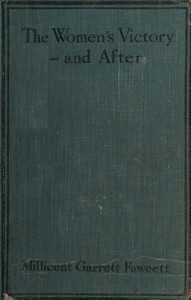
The Women's Victory—and After: Personal Reminiscences, 1911-1918 — Text and Context

(0 User reviews)   29
In Category - Biographies
Fawcett, Millicent Garrett, Dame, 1847-1929 Project Gutenberg 2015 Not confirmed
Women -- Suffrage -- Great Britain; Suffragists -- Great Britain -- Biography; Fawcett, Millicent Garrett, Dame, 1847-1929 Readers of public-domain and historical texts
Project Gutenberg digital edition en

Edition facts

Words 44,595
Reading time 194 min
Text sections 13

The catalog record for The Women's Victory—and After: Personal Reminiscences, 1911-1918 — Text and Context provides practical reading context through 44,595 words, 3 hr 14 min estimated reading time, and 13 detected text sections.

The text analysis averages about 23.1 words per sentence, while the detected sections provide another way to judge how the source is divided.

Project Gutenberg metadata also associates the work with “Women -- Suffrage -- Great Britain,” connecting these edition facts with the source record’s subject description.

Millicent Garrett Fawcett's 1920 memoir traces the final years of the British suffrage campaign from 1911 to 1918, focusing on organizational strategy, the shift to war work, and the eventual passage of partial enfranchisement. The narrative moves between parliamentary defeats, public demonstrations, and the establishment of all-women hospital units in France, using Punch cartoons as visual markers of changing public sentiment.
Share
Editorial Edition Score 4.8/5

Calculated from edition completeness, EPUB availability, text structure and catalogue metadata. Not a user rating.

How this score is calculated
  • Description quality20 pts
  • Title & short description10 pts
  • Source metadata20 pts
  • Text length15 pts
  • Chapters / structure15 pts
  • EPUB file integrity20 pts

Total of 100 points, scaled to a 2.5-5.0 range. Editions with an empty description or a missing EPUB file are not scored.

Edition quality

Read the Text

he Session of 1912 with two strings to their bow. The first was a definite promise from the Prime Minister of a week, or more if necessary, of parliamentary time for the Second Reading and all the necessary subsequent stages of the Conciliation Bill.

The second string was embodied in the series of promises given by Mr. Asquith to the suffrage deputation described in the last chapter. These promises we had been assured by Mr. Lloyd George were of the very utmost value; to cast doubt upon them was "an imputation of deep dishonour" which he vehemently repudiated. Sir Edward Grey shared Mr. Lloyd George's opinion, and assured us that we now had "a real opportunity" of victory.

Our first struggle was over the Second Reading of the Conciliation Bill, and it was not long before we discovered that the dice were being loaded against us. We had, however, in our favour the big majorities for the Bill in 1910 and 1911, the promises and past support of M.P.'s of all the parties, numbering more than half the House of Commons. This position seemed too strong to be abandoned, and we therefore encouraged our friends in the House to ballot for a day for the Second Reading. The 28th of March was secured. The text and title of the Bill were exactly the same as had been read a second time the previous year by a majority of 167.

As the day for the Second Reading approached we became aware that all kinds of new influences hostile to us were in operation. These were for the most part in the nature of Lobby gossip, and, not being publicly made, could not be publicly refuted. One, however, had been made public—viz., Mr. MacCallum Scott's appeal to Liberals, published in the _Standard_, as mentioned in the last chapter, not to allow their leader, Mr. Asquith, to be subjected to "the humiliation" of having to fulfil the promises he had given to suffragists in the previous November. This method of detaching Liberal M.P.'s from the support of the Bill was very freely used. It was said that if this Bill were carried it would break up the Ministry, and in particular it was widely rumoured that the Prime Minister and other antisuffrage members of the Government would resign. These rumours were never contradicted. Mr. Lloyd George's name was also freely used in this connection. Had he not openly expressed his dislike of the Bill? He had spoken against it in 1910; and in his speech at Bath in November, 1911, he had boasted that it had been "torpedoed" by the promise of a wider measure. The Irish Nationalists were peculiarly susceptible to the line of argument that the success of women's suffrage would mean the break up of the Government. The Home Rule Bill had been passed in all its stages twice by the House of Commons in two successive Sessions, but it required, under the Parliament Act, to be passed three times in three successive Sessions before it could be placed on the Statute Book, notwithstanding its rejection by the House of Lords. The continued violence of the militants—smashing windows, slashing the canvas of valuable pictures, burning the contents of letter-boxes, letting off explosives in empty churches, etc.—caused intense irritation and resentment among the general public, and afforded an excuse to those M.P.'s who had promised their support to our movement to break their word. On March 28th thirteen members of the Labour Party were absent in their constituencies in consequence of the labour unrest connected with the coal strike. The result of this combination of unfavourable conditions resulted in the defeat of the Bill by a majority of 14. Our Labour supporters could have saved the Bill had they been present in their full strength. It was a heavy disappointment, and the utmost was of course made of it by the antisuffragists, including, first and foremost, Mr. Asquith.

Analyzing the causes of our defeat, we found that, whereas in 1911 thirty-one followers of Mr. John Redmond had supported the Bill, including Mr. William Redmond, Professor Kettle, Mr. Stephen Gwynn, and other men in a leading position in their party, in 1912 not a single one voted for it. The only Irish Nationalists who continued their support to the Bill were three O'Brienites, Mr. William O'Brien himself, Mr. Timothy Healy, and Mr. Gilhooley. Twenty-two Liberals, twelve Nationalists, and eight Conservatives, who had hitherto supported the Bill, now voted against it. A far larger number withdrew their support, but did not give a hostile vote.

Fawcett opens her account not with a declaration of victory but with the image of two deputations—one to the Prime Minister, the other to the Foreign Secretary—in 1911. This double movement sets the pattern for a memoir that repeatedly shuttles between official channels and grassroots action. The book's structure mirrors the campaign's own rhythm: parliamentary setbacks are immediately followed by new organizational initiatives, from the Election Fighting Fund to the Pilgrimage of 1913. Fawcett's voice is measured, often understated, but she punctuates the narrative with precise financial figures—£213 in hand for the Scottish Women's Hospitals in October 1914, growing to £428,905 by August 1919—that ground her personal reminiscences in concrete achievement.

Parliamentary Defeats and Strategic Pivots

The early chapters document a series of legislative reversals: the Conciliation Bill's defeat, the fiasco of the Government Reform Bill. Fawcett does not dwell on disappointment; instead, she records how each setback produced a tactical response. The Election Fighting Fund, for instance, was created to oppose candidates who blocked suffrage, a move that shifted pressure from Parliament to the constituencies. She notes the precise sums raised and the number of seats contested, treating political arithmetic as a form of argument. The narrative moves briskly from one parliamentary session to the next, with little introspection, as if the author's personal feelings were subordinate to the movement's forward momentum.

The Pilgrimage and the Derby Day, 1913

Fawcett devotes a chapter to the National Union's 1913 Pilgrimage, a mass march from various points in Britain converging on London. She describes the orderly processions, the speeches at Hyde Park, and the contrast with militant tactics. The Derby Day incident—Emily Wilding Davison's fatal injury—is mentioned only obliquely, as a disruption that the constitutional wing sought to distance itself from. Fawcett's focus remains on the Pilgrimage's scale and discipline: the number of contingents, the weather, the behavior of the crowds. She uses the episode to illustrate the movement's capacity for peaceful mass mobilization, a theme that recurs throughout the book.

War Work as Political Argument

The outbreak of war in 1914 transforms the narrative. Fawcett catalogs the immediate suspension of militant activity and the rapid organization of women's war services. She highlights the Scottish Women's Hospitals, founded by Dr. Elsie Inglis, as a project that combined medical professionalism with suffrage networks. The hospitals were staffed entirely by women—surgeons, nurses, drivers, orderlies—and eventually operated over 1,800 beds in France and Serbia. Fawcett includes a telling exchange: a Highlander patient asked if there were no men surgeons, replied, 'And what would we be wanting men for?' Such vignettes serve as evidence that women's competence in wartime undermined arguments against their enfranchisement.

The Turn of the Tide and the 1918 Act

The final chapters trace the shift in public opinion during the war years. Fawcett records the gradual acceptance of women's suffrage by former opponents, including the anti-suffragist Mrs. Humphry Ward, who undertook patriotic work. The Representation of the People Act 1918 is presented not as a sudden triumph but as the culmination of decades of organizational labor. Fawcett's tone remains restrained; she does not claim personal credit. Instead, she reproduces the Punch cartoon 'At Last!' as a frontispiece, letting the image carry the emotional weight. The memoir closes with a chapter on 'The Difference the Vote Has Made,' which speculates cautiously on future political participation.

Fawcett's memoir is best read as a document of organizational history rather than personal revelation. She rarely appears as an individual; her 'I' is almost always the voice of the National Union. Readers interested in the internal debates of the suffrage movement will find detailed accounts of strategy and finance. Those seeking dramatic confrontation or character study should look elsewhere. The book's value lies in its precise chronology, its financial records, and its demonstration of how a political movement sustained itself through repeated legislative defeats. The appendix and index make it a useful reference for researchers.

That memoir left me thinking about how people keep going through public disappointment—how Fawcett’s quiet persistence outlasted every setback. It reminded me of the patience in A Biography of Edmund Spenser — Themes and Context, how a life’s meaning often only appears in hindsight. Both felt like sitting with someone who knew waiting wasn’t weakness.

There are no reviews for this eBook.

0
0 out of 5 (0 User reviews )

Add a Review

Your Rating *
  • ...
    Olivia Mary Butler - 1 month ago
    This memoir is an invaluable firsthand account of the British suffragette movement's final, triumphant years. The author's personal reminiscences provide a raw, emotional depth to the political struggle, from prison cells to the victory after the First World War. Her narrative voice is both passionate and clear-sighted, making this an essential read for anyone interested in women's history or social change.

  • ...
    Laura Hunter - 2 weeks ago
    A vivid and historically significant memoir that captures the fervor of the suffrage movement. The personal stories are moving and bring the era to life. The author's perspective is, naturally, one-sided, and sometimes the narrative jumps between events without clear context. Still, it's a crucial piece of primary source material that complements standard history texts.

  • ...
    Ariana Brennan - 2 weeks ago
    While this memoir is historically important, it fails as a compelling read for a modern audience. The writing is often repetitive and focuses excessively on internal political squabbles among suffragettes, which will bore general readers. A heavy bias and lack of historical contextualization also make it unreliable as a standalone resource. Only for specialized scholars with a high tolerance for jargon.


Reader reflection

What was your reading experience?

Capture what you thought, learned, and would like to remember.

Your progress 0 / 10
1

Which reading stage best describes you?

2

How did the book work for you overall?

3

Is this a title you would suggest to others?

4

What was the reading difficulty like?

Related eBooks