1

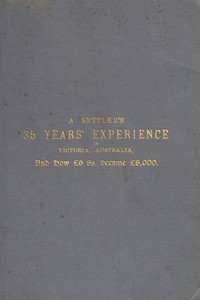
A Settler's 35 Years' Experience in Victoria, Australia And how £6 8s. became £8,000 — Context and Discussion
(0 User reviews)
3554
Project Gutenberg
2018
Not confirmed
Hulme, E. (Edward), 1818-1904; Immigrants -- Australia -- Biography; Victoria -- Biography
Readers of public-domain and historical texts
Project Gutenberg digital edition
en
Edition facts
Words
18,677
Reading time
82 min
Text sections
2
For A Settler's 35 Years' Experience in Victoria, Australia And how £6 8s. became £8,000 — Context and Discussion, the stored edition analysis reports 18,677 words, 1 hr 22 min estimated reading time, and 2 detected text sections.
The text analysis averages about 21.4 words per sentence, while the detected sections provide another way to judge how the source is divided.
Project Gutenberg metadata also associates the work with “Hulme, E. (Edward), 1818-1904,” connecting these edition facts with the source record’s subject description.
Source:
Project Gutenberg record #57471
Edward Hulme, a former artist turned farmer, recounts his 35-year journey from London to Victoria, Australia, transforming £6 8s. into £8,000. The narrative blends personal memoir with practical advice on temperance, farming, and land settlement, offering a firsthand view of colonial life.
Editorial Edition Score
4.5/5
★★★★★
★★★★★
Calculated from edition completeness, EPUB availability, text structure and catalogue metadata. Not a user rating.
How this score is calculated
- Description quality20 pts
- Title & short description10 pts
- Source metadata20 pts
- Text length15 pts
- Chapters / structure15 pts
- EPUB file integrity20 pts
Total of 100 points, scaled to a 2.5-5.0 range. Editions with an empty description or a missing EPUB file are not scored.
Edition quality
Read the Text
This was a great blow to us, as we should have saved our passage money, and had a salary besides; I think about £150 as schoolmaster, and wife as matron. Parties told me I could have managed it if I had liked, by getting some of the passengers to take the other four children; but this I could not do from principle. To pay our passage in a general passage ship, therefore, exhausted all our little means.
Farewell to Dear Old England.
We did intend taking our passage in the new ship "Schomberg," just launched, and owned by "The White Star Company." On enquiring at the London office, they informed me that I could send our goods on to Liverpool, but they would not be put on board any ship until our passage money was paid, and that I should find them in the company's warehouse in Liverpool; consequently, I sent the goods on. We could not, however, get ready to go by the "Schomberg." On arriving at Liverpool, and enquiring for our luggage, I found it had been sent on in that vessel.
Now, the fate of that fine new ship, I presume, is generally known. The captain had a bet with the captain of the ship "Kent," a well known clipper, and declared "if he did not beat the 'Kent,' he would knock her ('the Schomberg's') bows in." On hearing that the "Kent" had made the passage before him, the "Schomberg" was wilfully run on shore, just a little way from Cape Otway. Luckily, it was fair weather, and the passengers and crew were taken safely off, but with only the luggage they could carry in their hands; there being only just standing room on board the rescuing steamboat. The "Schomberg" became a total wreck. This, I suppose, is one of the most wicked and shameful incidents that ever happened on the shores of Australia. We took our passage in the next ship; the good ship "Sultana," from Liverpool, on the 21st October, 1855.
I remember, as we weighed anchor, being some distance out in the stream, and out of hearing of any friendly cheer, a serious calm appeared to pervade the ship; all appeared absorbed with their own thoughts, when we found the ship was under way, more by the apparent moving of the receding shore; she being a sailing vessel. I don't know the feelings of the other passengers; possibly many were like our own, at departing from the good "Old Land." Hitherto, we had borne up well in parting from kindred and friends. We said "Good-bye" in London; but now, in those few calm moments, seated upon the ship's deck, with wife, six sons, and a baby girl around us, we felt the necessity of faith in that good Providence on Whom we had cast the future. Our feelings, however, would have vent in a few hot tears, but these had to be brushed quickly on one side.
Edward Hulme opens his memoir by positioning himself as a "soft-handed" artist who, after exhibiting at the Royal Academy and suffering nervous typhus, abandoned his London career for the Australian diggings. The book's subtitle—"how £6 8s. became £8,000"—announces a financial transformation, but the early pages dwell on artistic ambition and physical collapse, not gold. Hulme's voice is direct and self-deprecating, calling himself a "struggling professor" and framing the book as advice for "hard-handed men" and "soft-handed ones also."
The table of contents reveals a hybrid structure: a personal "Sketch of Artist Life" gives way to chapters on farming, irrigation, and temperance. Hulme does not promise a continuous story; instead, he offers a life sketch punctuated by practical dissertations. Readers should expect a work that shifts between autobiography and advocacy, with the author's moral convictions—especially on alcohol—woven throughout.
From Royal Academy to the Diggings
Hulme's account of his early life is unusually specific for a settler narrative. He notes that his works "were hung in a creditable position on the walls of the Royal Academy" and that he studied there as a student. The turning point comes not from a desire for adventure but from overwork: he contracted "nervous typhus fever" while preparing a competition piece for the Houses of Parliament. This medical detail grounds his decision to emigrate in physical necessity rather than romantic ambition.
The journey itself is compressed. Hulme mentions a "Farewell to Dear Old England" and a chapter titled "Melbourne at Last," but the excerpts skip the voyage. What emerges is a man who carried his professional identity across oceans—he remained an artist even as he became a digger and farmer. The opening chapters establish a pattern: Hulme presents himself as someone who failed in one sphere and succeeded in another, but who never fully discards his former self.
Ten Years on the Diggings
The chapter "Ten Years on the Diggings" is listed in the contents but not fully excerpted. However, the surrounding material suggests that Hulme's goldfields experience was not his final destination. He writes of moving from the diggings to farming, then to increasing his land holdings. The phrase "Off for 200 Miles' Tramp" (used as a caption) hints at the physical scale of his travels.
What is clear from the excerpts is that Hulme measures success in land and money, not in gold nuggets. The book's subtitle promises a financial arithmetic, and the chapter titles—"Commence Farming," "Increase of Holdings," "The Consummation"—trace a deliberate progression. Readers should note that Hulme rarely describes the diggings themselves; instead, he uses them as a stepping stone. His focus is on the system that turned a small stake into a substantial fortune, and on the moral habits that made it possible.
Temperance as a Settler's Virtue
Hulme devotes an entire chapter to "A Dissertation on Temperance," and the excerpts reveal a personal crusade. He dates his own pledge to 1841 and claims that "the whole of my children have followed our example." His father, a naval man who fought under Nelson, died early from drink, leaving a widow with six children. Hulme uses this family history to argue that alcohol is a "curse of the race" and that abstainers prosper in the colony.
The argument is not merely moral but economic. Hulme asserts that "I never knew an abstainer but what prospered in this colony, and I have known hundreds of drinkers 'go to the wall.'" He offers specific examples: two "drunk out" farms he purchased, and a warning that vineyard owners who made wine were "bitten by his own dog." This chapter is the most polemical in the excerpts, and it reveals Hulme's conviction that personal discipline underpins material success.
Advice on Land, Irrigation, and the Future
The later chapters shift from autobiography to policy. Hulme writes on "The Settlement of the Lands," "Irrigation," and "A Scheme of Settlement," ending with "A Glimpse at the Future of Australia." These sections are addressed to prospective settlers and to colonial administrators. Hulme's tone becomes prescriptive: he advocates for irrigation, for systematic land distribution, and for temperance as a social reform.
The excerpts do not include the full text of these chapters, but the titles indicate a concern with infrastructure and governance. Hulme is not content to tell his own story; he wants to shape the colony's development. His advice is grounded in 35 years of experience, but it is also idealistic—he imagines a future where Australia avoids the mistakes of the Old World. Readers should approach these chapters as a settler's manifesto, blending personal testimony with public argument.
Hulme's memoir is best read as a layered document: part personal history, part moral treatise, part practical guide. The excerpts show a man who never stopped being an artist even as he became a farmer—he frames his life as a composition, with setbacks, turning points, and a clear moral arc. Readers interested in colonial history will find specific details about land acquisition and temperance advocacy; those seeking a narrative should be prepared for digressions. Hulme's voice is earnest and opinionated, and his book rewards attention to its structure as much as its content.
Edward Hulme’s patient ledger of colonial toil—six pounds turned to thousands—sits quietly beside a soldier’s seventeen years abroad, each man measuring time by what the soil or the sword demanded. One counts in sovereigns, the other in marches, yet both speak of endurance. My hand seems to hover between them, The Military Sketch-Book, Vol. 2 (of 2) Reminiscences of seventeen years in the service abroad and at home — Text and Context offering its own quiet arithmetic of discipline and distance.
There are no reviews for this eBook.
There are no comments for this eBook.
Reader reflection
How will you remember this book?
Save your reaction, strongest insight, and memorable passage.
Your progress
0
/
10
2
How much did you enjoy the reading experience?
3
How likely are you to recommend this book?
4
How demanding did the text feel?
5
How useful did the reading feel?
6
How personally connected did you feel to the book?
7
Could you see yourself revisiting this book?
8
Which element worked best for you?
9
In one sentence, what did you learn?
10