1

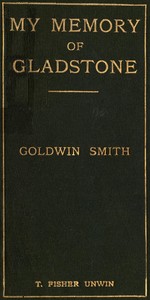
My Memory of Gladstone — Inside the Classic
(0 User reviews)
279
Project Gutenberg
2017
Not confirmed
Gladstone, W. E. (William Ewart), 1809-1898; Prime ministers -- Great Britain -- Biography; Statesmen -- Great Britain -- Biography
Readers of public-domain and historical texts
Project Gutenberg digital edition
en
Edition facts
Words
14,228
Reading time
62 min
Text sections
2
The source record for My Memory of Gladstone — Inside the Classic measures this digital text at 14,228 words, 1 hr 2 min estimated reading time, and 2 detected text sections.
The text analysis averages about 25.9 words per sentence, while the detected sections provide another way to judge how the source is divided.
Project Gutenberg metadata also associates the work with “Gladstone, W. E. (William Ewart), 1809-1898,” connecting these edition facts with the source record’s subject description.
Source:
Project Gutenberg record #55549
Goldwin Smith's 1904 memoir offers a firsthand but secondary account of W.E. Gladstone, focusing on his physical vigor, oratorical stamina, and political actions, particularly regarding Irish Home Rule, based on personal observation and close association with Gladstone's colleagues.
Editorial Edition Score
4.5/5
★★★★★
★★★★★
Calculated from edition completeness, EPUB availability, text structure and catalogue metadata. Not a user rating.
How this score is calculated
- Description quality20 pts
- Title & short description10 pts
- Source metadata20 pts
- Text length15 pts
- Chapters / structure15 pts
- EPUB file integrity20 pts
Total of 100 points, scaled to a 2.5-5.0 range. Editions with an empty description or a missing EPUB file are not scored.
Edition quality
Public-domain source text
Read the source text
The source text is kept in the dedicated reader, separate from this catalogue record and its commentary.
Goldwin Smith opens his memoir of W.E. Gladstone not with a cradle-to-grave narrative but with a pointed comparison to John Morley's official biography, positioning his own work as a supplement from a different vantage point. Smith declares he was never Gladstone's colleague or confidant, yet he enjoyed 'the closest intimacy with men who were his associates in public life,' allowing him to see Gladstone through their eyes. This framing immediately establishes the book's character: a personal recollection filtered through a network of political friendships, not a comprehensive life story.
A Portrait Drawn from Physical and Mental Stamina
Smith's most vivid passages dwell on Gladstone's extraordinary constitution. He describes Gladstone as 'a wonderful being, physically and mentally,' with an eye 'intensely bright' and a form that bespoke 'nervous energy.' The memoir recounts a four-hour speech on a financial subject that left a fastidious critic wishing for four more hours. Smith also details a working session that stretched from ten in the morning to six in the evening, interrupted only by a Privy Council meeting, after which Gladstone spoke in the House at one o'clock the next morning. Such anecdotes serve not as mere color but as evidence of the stamina Smith considers essential to understanding Gladstone's political effectiveness.
The Irish Question as a Test of Statesmanship
The latter portion of the excerpt shifts sharply from personal observation to historical analysis of Gladstone's Irish policy. Smith argues that the history of Ireland's economic degradation—from Cromwell's free trade to British protectionism, the Penal Code, and the famine—was 'never, so far as I remember, very clearly set forth' by Gladstone or his contemporaries. He contends that the real Irish grievance was agrarian, not political, and that Home Rule was a reduced version of O'Connell's repeal movement. Smith's tone becomes critical: he implies that Gladstone's biographer was 'restrained by his desire not to multiply points of controversy,' and that the last act of Gladstone's life, tied to Ireland, was 'scarcely of a brighter hue than the rest of that sad story.'
The Limits of a Secondary Witness
Smith is careful to mark the boundaries of his knowledge. He admits he was not a partner in Gladstone's counsels, and he relies on the testimony of friends like George Venables. When discussing the political movement, he notes that the struggle for Home Rule 'had, when Mr. Gladstone came to deal with the question, assumed the aspect of a struggle for Home Rule'—a phrasing that suggests he is summarizing rather than claiming insider insight. The memoir thus offers a valuable but deliberately partial view, one that supplements official biography with the texture of personal acquaintance and the perspective of a contemporary who moved in the same circles but remained at a certain distance.
Readers should approach My Memory of Gladstone as a companion piece rather than a standalone biography. Smith's observations are most useful when he reports what he saw or heard directly—Gladstone's working habits, his physical presence, the reactions of mutual acquaintances. His historical judgments on Ireland, while forcefully argued, reflect his own political stance and should be weighed against other sources. The memoir's brevity and focus make it a quick but nuanced entry into late-Victorian political memory.
Reading about Gladstone’s tireless speeches, I remembered my grandfather falling asleep mid-sentence, the paper open on his chest. It reminded me of how the private rooms behind public men—their wives, their quiet habits—felt more real than any parliament. The same warmth surfaced flipping through Wives of the Prime Ministers, 1844-1906 — Text and Context, where history breathes softly between agendas.
There are no reviews for this eBook.
There are no comments for this eBook.
Reader reflection
Your personal reading reflection
Build a private reading journal entry for this title.
Your progress
0
/
10
2
What was your overall reaction to the book?
3
Would you pass this book on to a friend?
4
What was the reading difficulty like?
5
Did you gain anything practical from the text?
6
How understandable was the text?
7
How would you rate its originality?
8
Did you relate to its people, ideas, or situations?
9
What is the main idea you are taking away?
10