1

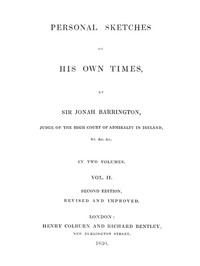
Personal sketches of his own times, Vol. 2 (of 3) — Background and Themes
(0 User reviews)
243
Project Gutenberg
2015
Not confirmed
Barrington, Jonah, Sir, 1760-1834; Judges -- Ireland -- Biography; Ireland -- Social life and customs -- 18th century; Ireland -- Social life and customs -- 19th century
Readers of public-domain and historical texts
Project Gutenberg digital edition
en
Edition facts
Words
111,223
Reading time
484 min
Text sections
30
Personal sketches of his own times, Vol. 2 (of 3) — Background and Themes can be approached with a clearer sense of reading commitment from its source measurements: 111,223 words, 8 hr 4 min estimated reading time, and 30 detected text sections.
The text analysis averages about 28.9 words per sentence, while the detected sections provide another way to judge how the source is divided.
Project Gutenberg metadata also associates the work with “Barrington, Jonah, Sir, 1760-1834,” connecting these edition facts with the source record’s subject description.
Source:
Project Gutenberg record #49793
Sir Jonah Barrington's second volume of memoirs focuses on Irish dueling culture, legal anecdotes, and a detailed portrait of actress Mrs. Jordan, blending personal observation with broader social commentary on late 18th- and early 19th-century Ireland.
Editorial Edition Score
4.9/5
★★★★★
★★★★★
Calculated from edition completeness, EPUB availability, text structure and catalogue metadata. Not a user rating.
How this score is calculated
- Description quality20 pts
- Title & short description10 pts
- Source metadata20 pts
- Text length15 pts
- Chapters / structure15 pts
- EPUB file integrity20 pts
Total of 100 points, scaled to a 2.5-5.0 range. Editions with an empty description or a missing EPUB file are not scored.
Edition quality
Public-domain source text
Read the source text
The source text is kept in the dedicated reader, separate from this catalogue record and its commentary.
Sir Jonah Barrington opens this volume with a dedication to Lord Stowell, noting that the general approval of his first volume prompted a suggestion for a third, “composed of similar materials.” The preface thus frames the work as a continuation of anecdotal memoir rather than systematic history. The table of contents immediately signals a preoccupation with dueling: chapters titled “The Fire-Eaters” and “Duelling Extraordinary” promise accounts of Irish dueling culture, complete with a list of “official and judicial duellists” and a code called the “Thirty-six Commandments.” Yet the excerpts also reveal a shift toward theatrical portraiture, particularly in the extended sketch of Mrs. Jordan, whose habits and reflections occupy a substantial portion of the text. This volume thus oscillates between two poles: the violent rituals of the Irish gentry and the private life of a celebrated actress.
Dueling as Social Theater
The catalog subjects list “Ireland — Social life and customs — 18th century” and “19th century,” and the excerpts confirm that Barrington treats dueling as a central social ritual. The chapter “The Fire-Eaters” describes a “passion for duelling in Ireland” and includes a “list of official and judicial duellists in author’s time.” Barrington presents dueling not merely as violence but as a codified performance: the “Fire-eaters’ Society” had “rules of duelling and points of honour” called the “Thirty-six Commandments.” One anecdote recounts a “ludicrous affair between Frank Skelton and an exciseman,” where Skelton “shoots the exciseman and runs away” with “curious reasons.” Another tells of “Honourable Barry Yelverton challenged by nine officers at once,” leading to an “elucidation of the Fire-eaters’ Resolutions.” These episodes suggest that dueling functioned as a form of social theater, with its own etiquette, humor, and absurdities.
Mrs. Jordan: The Actress Offstage
Barrington’s portrait of Mrs. Jordan occupies a significant portion of the excerpts, offering a counterpoint to the dueling narratives. He describes her daily routine: “in the mornings she usually seemed depressed; at noon she went to rehearsal—came home fatigued, dined at three, and then reclined in her chamber till it was time to dress.” The contrast between her offstage languor and onstage vitality is stark: “the moment her foot touched the scenic boards her spirit seemed to be regenerated.” Barrington records her own explanation: “Habit! old habit! … I told Nature I was then at her service … I became, in fact, merely her puppet.” This self-deprecating account of her craft reveals a performer who attributed her success to instinct rather than calculation. Barrington also notes that during her 1809 visit to Dublin, she “disappointed all” in private society because “there was about her no display.” The sketch thus emphasizes the gap between public performance and private demeanor.
Legal and Personal Anecdotes
Barrington’s position as a judge informs many of the sketches. The catalog subject “Judges — Ireland — Biography” is reflected in anecdotes about legal figures, such as “Lord Kilkenny’s memorable duels and law-suits” and “his lordship is shot by Mr. Ball, an attorney.” The volume also includes a “singular duel between the author and Mr. Richard Daley,” where Barrington himself is a participant. His second is the “celebrated Balloon Crosby,” described as having a “singular appearance and character.” These personal vignettes blend legal observation with memoir. Barrington’s tone is often wry, as when he notes that a dueling code was “called the Thirty-six Commandments.” The excerpts do not reveal the outcome of many episodes, but they establish Barrington as a narrator who is both insider and commentator, using his own experiences to illuminate the customs of his time.
Readers should approach this volume as a collection of discrete sketches rather than a continuous narrative. Barrington’s voice is that of a participant-observer, and his judgments are often implicit in the anecdotes he chooses to tell. The excerpts suggest that the book rewards those interested in the intersection of legal history, social ritual, and theatrical biography. Because the text is incomplete in the excerpts, some episodes may lack resolution, but the vividness of Barrington’s detail compensates for any gaps.
The rain kept Sir Jonah’s duels and Mrs. Jordan’s laughter company that afternoon. His gossip about Georgian drawing-rooms made me wonder what those same rooms held later, when political wives bore the weight of it all. By dusk, I had turned to Wives of the Prime Ministers, 1844-1906 — Text and Context instead, another kind of stage, quieter but no less storied.
There are no reviews for this eBook.
There are no comments for this eBook.
Reader reflection
Before you leave, reflect on the book
Use these questions to collect your thoughts before moving on.
Your progress
0
/
10
2
How did the book work for you overall?
3
Is this a title you would suggest to others?
4
How demanding did the text feel?
5
How would you describe its reading pace?
6
Did this book create an emotional response?
7
Do you expect to return to this book?
8
How would you rate its originality?
9
In one sentence, what did you learn?
10