1

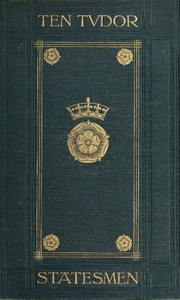
Ten Tudor Statesmen — A Closer Reading
(0 User reviews)
65
Project Gutenberg
2015
Not confirmed
Statesmen -- Great Britain -- Biography; Great Britain -- History -- Tudors, 1485-1603 -- Biography; England -- Civilization -- 16th century
Readers of public-domain and historical texts
Project Gutenberg digital edition
en
Edition facts
Words
99,704
Reading time
434 min
Text sections
19
Before opening Ten Tudor Statesmen — A Closer Reading, the edition data offers a quick orientation: 99,704 words, 7 hr 14 min estimated reading time, and 19 detected text sections.
The text analysis averages about 27.2 words per sentence, while the detected sections provide another way to judge how the source is divided.
Project Gutenberg metadata also associates the work with “Statesmen -- Great Britain -- Biography,” connecting these edition facts with the source record’s subject description.
Source:
Project Gutenberg record #48057
Arthur D. Innes profiles ten Tudor statesmen, focusing on character and political influence rather than narrative history. The preface notes that eight were ministers, none of noble birth, and four died on the scaffold.
Editorial Edition Score
4.9/5
★★★★★
★★★★★
Calculated from edition completeness, EPUB availability, text structure and catalogue metadata. Not a user rating.
How this score is calculated
- Description quality20 pts
- Title & short description10 pts
- Source metadata20 pts
- Text length15 pts
- Chapters / structure15 pts
- EPUB file integrity20 pts
Total of 100 points, scaled to a 2.5-5.0 range. Editions with an empty description or a missing EPUB file are not scored.
Edition quality
Public-domain source text
Read the source text
The source text is kept in the dedicated reader, separate from this catalogue record and its commentary.
In the preface to Ten Tudor Statesmen, Arthur D. Innes states his aim is to form a clear conception of character, not to write a history of the Tudor period. He emphasizes the need to understand each man's point of view and preconceptions, warning that judging by modern standards produces a dramatic figure, not the real person. The preface also notes two striking patterns: among the eight ministers profiled, none were of noble birth, and four died on the scaffold, illustrating the distance between Tudor politics and our own era.
The Preface as a Reading Lens
Innes opens with a methodological statement that shapes the entire book. He writes that events are considered not for their intrinsic importance but as they bear on character. This is not a conventional biographical collection; it is a series of character studies. The preface also reveals that Innes expects his own view of each figure to shift as he adopts their perspective. For a first-time reader, this is a useful cue: the book is less about what happened than about why these men acted as they did.
Patterns of Birth and Fate
Innes highlights two patterns in the preface. First, eight of the ten statesmen were ministers, and not one was of noble birth; two were not even of gentle birth. This, he says, emphasizes the change in political center of gravity under the Tudors. Second, of those eight ministers, four died on the scaffold and one at the stake; a sixth was under treason accusation when death released him. These stark facts frame the collection as a study of both achievement and peril. The reader is warned that success in Tudor politics often came with mortal risk.
The Somerset Excerpt: Character in Action
The excerpt on Edward Seymour, Duke of Somerset, shows Innes's method. He describes Somerset's rise after Henry VIII's death, noting that the will's genuineness has been disputed but probably without sufficient reason. Innes then analyzes Somerset's character: he lacked the personality to command unquestioning obedience and had an unerring sense of limits. The result was that he continued Henry's autocratic use of proclamations without the statutory power or personal force to make them effective. This is a concrete example of how Innes ties character to political outcome.
Structure and Selection
The table of contents reveals a consistent structure: each statesman gets multiple chapters, often beginning with an introductory or appreciations section. The chapters cover early years, rise to power, key policies, and character. The selection includes Henry VII, Wolsey, More, Cromwell, and others, spanning the Tudor dynasty. Innes does not claim to cover all major figures; he chooses those who embodied political ideas or exercised influence. The reader should expect focused analysis rather than comprehensive biography.
Innes's preface is the best guide to reading this book. He asks the reader to set aside modern preconceptions and try to see each statesman from his own vantage point. The result is a set of portraits that are often sympathetic but never naive about the dangers of Tudor politics. The book rewards those who read with attention to Innes's judgments and the evidence he selects.
There’s something sobering about how Innes lets those four scaffold deaths linger between the lines—men who shaped a realm and ended on Tower Hill. It makes me think of Brooke, who carved his own strange empire far from any court, yet answered to no one but himself. A quiet counterweight, that Rajah Brooke — Key Ideas to Explore volume, sitting beside it on my shelf.
There are no reviews for this eBook.
There are no comments for this eBook.
Reader reflection
Before you leave, reflect on the book
Use these questions to collect your thoughts before moving on.
Your progress
0
/
10
2
Did this book hold your interest?
3
Would you pass this book on to a friend?
4
What was the reading difficulty like?
5
Did you relate to its people, ideas, or situations?
6
What did you appreciate most?
7
How useful were the ideas in this book?
8
Did the story or argument move comfortably?
9
Which lesson or insight stayed with you?
10